
TCGPlayer vs eBay Selling MTG Singles in 2026
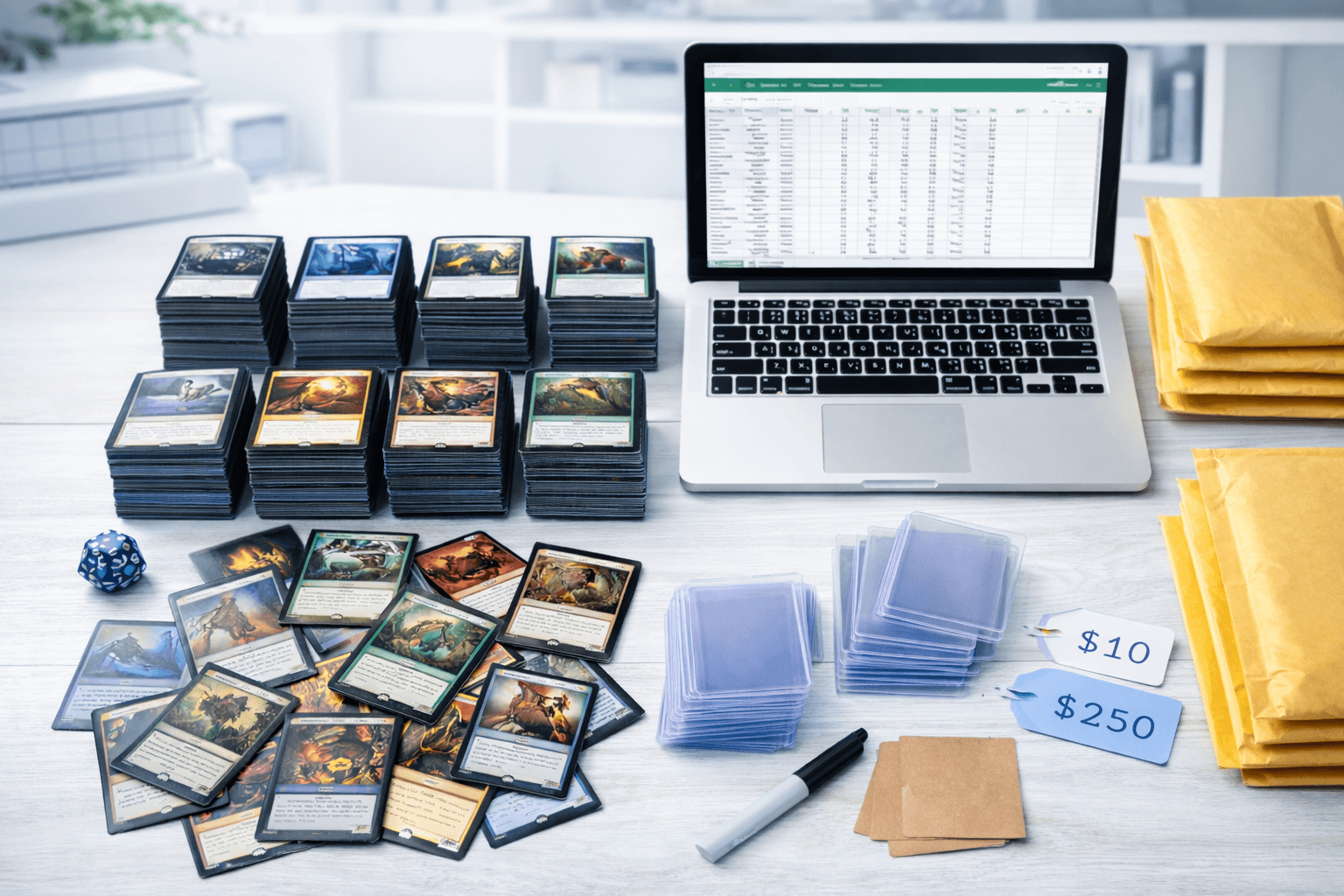
If you're weighing TCGPlayer vs eBay selling MTG cards, you're asking the right question at the right time. Both platforms moved the goalposts in the last year. TCGPlayer bumped its marketplace commission to 10.75% in February 2026, and eBay keeps running promos that slash final value fees on high-end singles. The “best” platform depends entirely on what you're selling, how much of it you have, and how quickly you want to start moving cards.
I sell on both platforms. I've shipped thousands of MTG singles through eBay and I've watched friends grind through TCGPlayer's seller level system. What I've learned is that the TCGPlayer vs eBay selling MTG debate doesn't have a single winner. They each win in different situations, and the smart play is understanding where each one shines so you can make the decision that puts the most money in your pocket.
Here's the honest breakdown.
TCGPlayer vs eBay Selling MTG: How the Fees Compare
Let's start with the number everyone cares about. On the surface, TCGPlayer looks cheaper. In practice, it's more complicated than that.
TCGPlayer's fee structure (as of February 2026):

eBay: Open the Floodgates on Day One
eBay works differently. When you create a seller account, you get 250 free listings per month right out of the gate. There's no seller level system that restricts how many items you can have live. There are some initial selling limits for brand-new accounts, but eBay is generally much more permissive about letting new sellers list in volume.
More importantly, eBay supports bulk listing through CSV file uploads. You can create a spreadsheet with hundreds of listings, all with the correct item specifics, images, and pricing, then upload the entire batch in minutes. This is the workflow that tools like MTG Bulk Caster are built around.
With MTG Bulk Caster, you can export your collection from apps like Manabox, Moxfield, or Archidekt, run it through the tool to generate an eBay-compatible CSV with card images, eBay categories, and item specifics already filled in, set your pricing rules, and bulk upload hundreds of listings in a single session. You don't need to wait for a seller level to unlock. You don't need to earn the privilege of listing more than 100 cards. You can go from “I have a box of cards” to “I have 500 live eBay listings” in under an hour on your first day.
That speed difference is the single biggest practical gap between the two platforms for someone sitting on a collection right now.
Buyer Audience: Who's Shopping Where
The audience on each platform is fundamentally different, and this matters more than most sellers realize when evaluating TCGPlayer vs eBay selling MTG singles.
TCGPlayer's buyer base is almost entirely Magic players. These are people who know what they're looking for, search by set and card name, and price-compare aggressively. TCGPlayer's Cart Optimizer scours every seller to build the cheapest possible order, which means pricing competitively isn't optional. It's survival. If your card is $0.05 more than the next seller, the Cart Optimizer routes that buyer elsewhere.
This is great if you have competitively priced staples and high-demand singles. It's less great if you're trying to move above-bulk rares and niche cards that aren't on everyone's shopping list.
eBay's buyer base is broader. You're reaching Magic players, sure, but also casual collectors, nostalgia buyers, parents looking for gifts, and people who search “cool fantasy card” at 11 PM. eBay's search algorithm also surfaces your listings to people who weren't specifically looking for them, through recommended items, category browsing, and promoted listings.
For cards in the $2 to $10 range, eBay often produces better sell-through rates because you're not competing exclusively on price against every other seller listing the exact same card. A buyer on eBay might pay $4.50 for a card they could get for $3.80 on TCGPlayer simply because they found your listing first and the buying experience was smooth.
Shipping: The Hidden Differentiator
Shipping policy is where eBay quietly wins for small sellers in the TCGPlayer vs eBay selling MTG matchup.
eBay Standard Envelope (ESE) lets you ship individual trading cards for around $1 using a tracked, lightweight envelope. It's designed specifically for cards. It's cheap. It's easy. For sellers moving $2 to $10 singles, ESE is the reason those cards are profitable to sell in the first place.
On TCGPlayer, shipping is more structured. New sellers have limited control over their shipping rates until Level 4. TCGPlayer sets default shipping tiers based on order size, and those defaults can eat into your margins on cheap singles. The minimum shipping for orders under $5 is $1.31, which on a $2 card means shipping costs more than half the card's value.
Both platforms require tracking on higher-value orders, and both offer packaging flexibility. But eBay's Standard Envelope program specifically serves the MTG singles seller better than anything TCGPlayer offers at the entry level.
Pricing Control and Listing Quality
This is one area where TCGPlayer genuinely excels in the TCGPlayer vs eBay selling MTG comparison. Listing a card on TCGPlayer is fast because the catalog already exists. You search for the card, select the condition, enter your price, and you're done. No photos needed. No item description to write. No category to select. The infrastructure handles it.
On eBay, every listing needs a title, item specifics, category assignment, photos, and a description. Doing this manually for hundreds of cards would take forever. That's the entire reason tools like MTG Bulk Caster exist. The tool pulls card images, maps the correct eBay categories and item specifics, and generates the complete listing data from your collection export. It turns what would be a five-to-ten minute per-card process into a batch job.
TCGPlayer also has sharper pricing tools. The Price Differential Report shows you how your prices compare to TCG Low and Market Price in real time. eBay's pricing tools are more generalized and not MTG-specific, which means you'll want to cross-reference TCG prices when setting your eBay BIN prices.
When TCGPlayer Is the Better Choice
TCGPlayer wins when you're selling high-demand, tournament-playable singles to an audience that already knows what they want. If you have a pile of format staples, chase cards from recent sets, or EDH all-stars, TCGPlayer's built-in buyer base and catalog system make listing fast and efficient.
TCGPlayer is also better if you're already an established seller at Level 3 or 4. At that point, the listing process is arguably the smoothest in the business. No photos, catalog-driven pricing, and a buyer pool that actively searches for specific cards.
And if you run a brick-and-mortar shop, TCGPlayer Pro gives you tools that eBay simply doesn't offer, including in-store kiosk integration, a custom website, and direct fulfillment through TCGPlayer Direct.
When eBay Is the Better Choice
eBay wins when you need to sell now, sell in volume, or sell cards that aren't hot-ticket staples. For most people asking about TCGPlayer vs eBay selling MTG cards for the first time, eBay is the faster path to revenue.
If you're a new seller with a collection to move, eBay lets you start listing in bulk on day one. Pair it with MTG Bulk Caster and you can go from a Manabox export to hundreds of live eBay listings in a single sitting. No seller levels to grind through. No 100-item cap. No waiting weeks to prove yourself.
eBay also wins for what I call “The $2 Card Problem.” These are cards worth more than buylist prices but not valuable enough to justify manual listing on any platform. They're the above-bulk rares, the casual commander staples, the foils from three sets ago. On eBay with bulk listing tools, these cards become profitable to sell for the first time because the listing time per card drops from minutes to seconds.
And for higher-value singles ($50+), eBay's massive buyer pool and auction format can drive prices above what you'd get at TCG Market Price, especially for scarce printings, misprints, or graded cards.
The Smart Play: Use Both Platforms Strategically
The sellers making the most money aren't choosing one platform over the other. They're using each one for what it does best. If TCGPlayer vs eBay selling MTG cards is the question, “both” is the real answer.
Here's one framework that works:
Cards over $20 with high tournament demand go on TCGPlayer, where the buyer pool is deepest for competitive singles and you can price to TCG Low with confidence.
Cards in the $2 to $20 range, especially casual and commander staples, go on eBay. Bulk list them with a tool like MTG Bulk Caster, ship with Standard Envelope, and take advantage of the broader buyer base.
Cards under $2 get sorted into lots or playsets and sold as bundles on eBay, or buylisted if the per-card value doesn't justify individual listing on either platform.
This isn't a one-size-fits-all answer to TCGPlayer vs eBay selling MTG singles. But it's the approach that consistently turns the biggest collection into the most cash with the least wasted time.
Frequently Asked Questions
Is TCGPlayer or eBay cheaper for selling Magic cards?
When comparing TCGPlayer vs eBay selling MTG cards, the percentage-based fees are similar on both platforms, landing around 13-14% for standard sellers. eBay edges ahead if you have a Store subscription, which lowers your final value fee to 12.35%. TCGPlayer has no listing fees, while eBay gives you 250 free listings per month before charging $0.35 per additional listing.
Can I start selling in bulk on TCGPlayer right away?
No. TCGPlayer's seller level system caps new sellers at 100 listed items until they complete enough orders to level up. Reaching Level 4 for unlimited listings requires 51 fulfilled orders with a 90% or higher feedback rating. This process typically takes weeks to months depending on your sales volume.
What is the fastest way to list MTG cards on eBay?
The fastest method is bulk uploading via CSV files. Tools like MTG Bulk Caster let you export your collection from apps like Manabox or Moxfield and generate an eBay-ready CSV with card images, categories, and item specifics already populated. You can list hundreds of cards in minutes instead of hours.
Does eBay have seller level restrictions like TCGPlayer?
eBay does have initial selling limits on new accounts, but they're much less restrictive than TCGPlayer's system. Most new sellers can list 250 items per month for free from day one, and eBay will often increase your limits quickly if you maintain good standing.
Which platform has better buyer traffic for MTG singles?
TCGPlayer has more concentrated Magic player traffic. eBay has a larger overall buyer pool that includes casual collectors and non-MTG-specific shoppers. TCGPlayer is better for high-demand staples. eBay is better for casual, commander, and above-bulk cards that benefit from a broader audience.
Should I sell MTG cards on both TCGPlayer and eBay?
If you have the bandwidth, yes. Many successful sellers list high-demand tournament staples on TCGPlayer and use eBay for everything else, especially cards in the $2 to $20 range. Just make sure you track your inventory across platforms so you don't oversell.
What are eBay Standard Envelope shipping costs for MTG cards?
eBay Standard Envelope lets you ship individual trading cards for approximately $1 with tracking included. It's specifically designed for lightweight card shipments and is one of the most cost-effective ways to ship singles on any platform.
AUTHOR BIO
Jake is the founder of MTG Bulk Caster, a Magic: The Gathering player, and a top-rated eBay seller who has shipped thousands of MTG singles. He built MTG Bulk Caster after spending one too many weekends manually listing $3 cards on eBay and wondering why nobody had solved this problem yet. He sells on both eBay and TCGPlayer and has strong opinions about when to use each one.
Some links in this article are affiliate links. If you buy through them, BulkCaster may earn a commission at no additional cost to you, and it helps keep our tools free. Thank you for the support.