
Every Smart Way to Buy Bulk MTG Cards and Actually Make Money Doing It
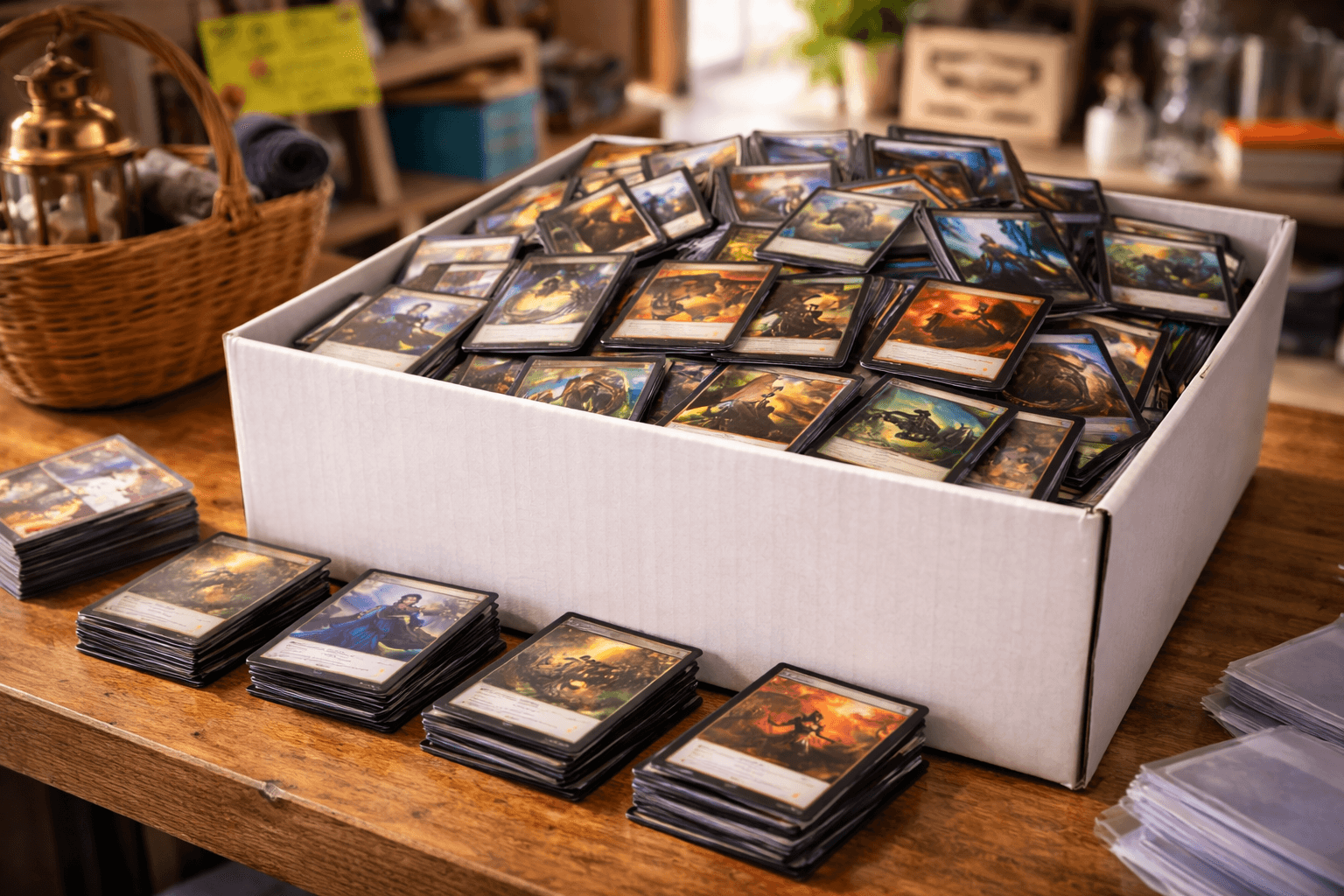
If you want to buy bulk MTG cards, you are either building a collection on a budget, trying to flip cards for profit, or both. Either way, the game is the same. Find bulk cheap, pick out the hidden value, and turn the rest into something useful. I have been buying and reselling Magic cards on eBay for years, and I can tell you that bulk is one of the most underrated entry points into MTG reselling. You just need to know where to look and what to look for.
This guide covers every legitimate source for buying bulk Magic: The Gathering cards in 2026, what you should expect to pay, how to sort through it efficiently, and how to actually make money on the other side. Whether you are a casual player looking for cheap cards to build decks or a side-hustle seller looking to buy bulk magic cards and flip them for profit, everything you need is right here.
What Counts as “Bulk” and What Should You Pay for It
Before you go hunting for deals, you need to understand what bulk actually means in the MTG community. Bulk cards are commons, uncommons, and low-value rares that typically sell for $0.10 or less on TCGplayer. These are the cards that pile up after drafts, come out of set boosters with a sigh, and end up in shoeboxes in closets across the country.
Here is how the community generally breaks down card value tiers:
Commons and Uncommons That Are Actually Worth Money
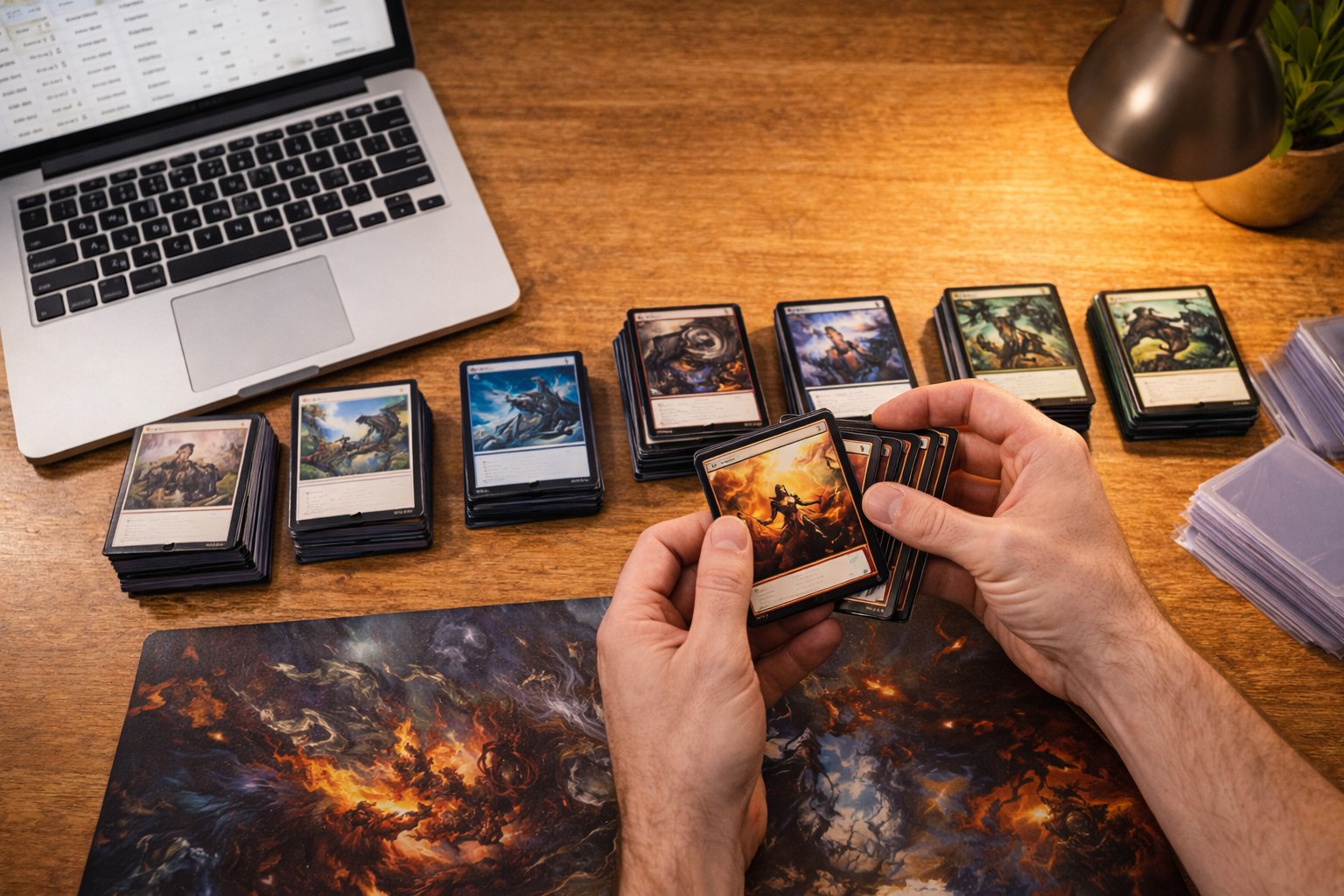
One of the biggest mistakes new bulk buyers make is assuming that commons and uncommons are worthless by default. They are not. Here are categories of commons and uncommons that regularly carry surprising value.
Commander staples at uncommon rarity. Cards like Swords to Plowshares, Sol Ring (in its uncommon printings), Vandalblast, and Exsanguinate maintain strong demand because Commander is the most popular constructed format. These cards get played in thousands of decks and their uncommon printings from reprint sets can still be worth $1 to $5.
Pauper format all-stars. Pauper only allows commons, which means high-demand commons can carry real price tags. Cards like Snuff Out, Gorilla Shaman, and various Pauper staples from older sets regularly buylist for $1 or more.
Cards with the “any number” clause. Cards like Hare Apparent from Foundations and Cid, Timeless Artificer from the Final Fantasy set incentivize players to buy dozens of copies. This inflated demand keeps their prices well above typical common and uncommon rates, often sitting at $2 to $6 per copy.
Competitive format crossovers. Stock Up from Aetherdrift became a staple across Standard, Pioneer, and even Vintage. Into the Flood Maw from Bloomburrow sees play across multiple competitive formats. Spelunking from The Lost Caverns of Ixalan revolutionized lands decks in Modern and Pioneer. These cards often sit at $3 to $7 despite being uncommon.
Portal Three Kingdoms and other limited-print-run sets. If you find cards from sets with small print runs, particularly older ones like Portal Three Kingdoms, Arabian Nights, or Legends, even the commons can be worth $5 to $20 or more. English printings of Portal Three Kingdoms were mostly limited to Australia and New Zealand, making even common cards from that set surprisingly valuable.
Old-border foils. Any foil from a set printed before 8th Edition (2003) commands a premium with collectors, regardless of rarity. Even common foils from sets like Onslaught or Mirrodin can be worth several dollars.
The bottom line: never assume a card is worthless based on its rarity symbol alone. Check first, bulk later.
Apps That Make Sorting Bulk Actually Bearable
Sorting bulk by hand and looking up every card individually is a recipe for burnout. These apps make the process dramatically faster.
Manabox
Manabox is the most popular free MTG collection management app, and for good reason. Its camera scanner identifies cards quickly and pulls real-time pricing from TCGplayer, Card Kingdom, Star City Games, and Cardmarket. You can scan cards directly into organized lists, then export your collection as a CSV file. This is especially useful if you plan to sell on eBay, because that CSV becomes the foundation for your listings. If you want to see exactly how that Manabox-to-eBay pipeline works, I wrote a full walkthrough on turning your Manabox collection into eBay listings.
Price: Free with optional premium subscription Best for: Scanning, price checking, and exporting collection data Platforms: iOS and Android
Delver Lens
Delver Lens is known for its fast card scanner that can capture multiple cards at once. Fan out a stack and scan them in one shot. It supports exports to multiple formats and integrates with several platforms. If speed is your priority and you want to blitz through a bulk lot, Delver Lens is worth trying.
Price: Free with optional premium features Best for: High-speed batch scanning Platforms: Android (iOS via Delver Lab)
TCGplayer App
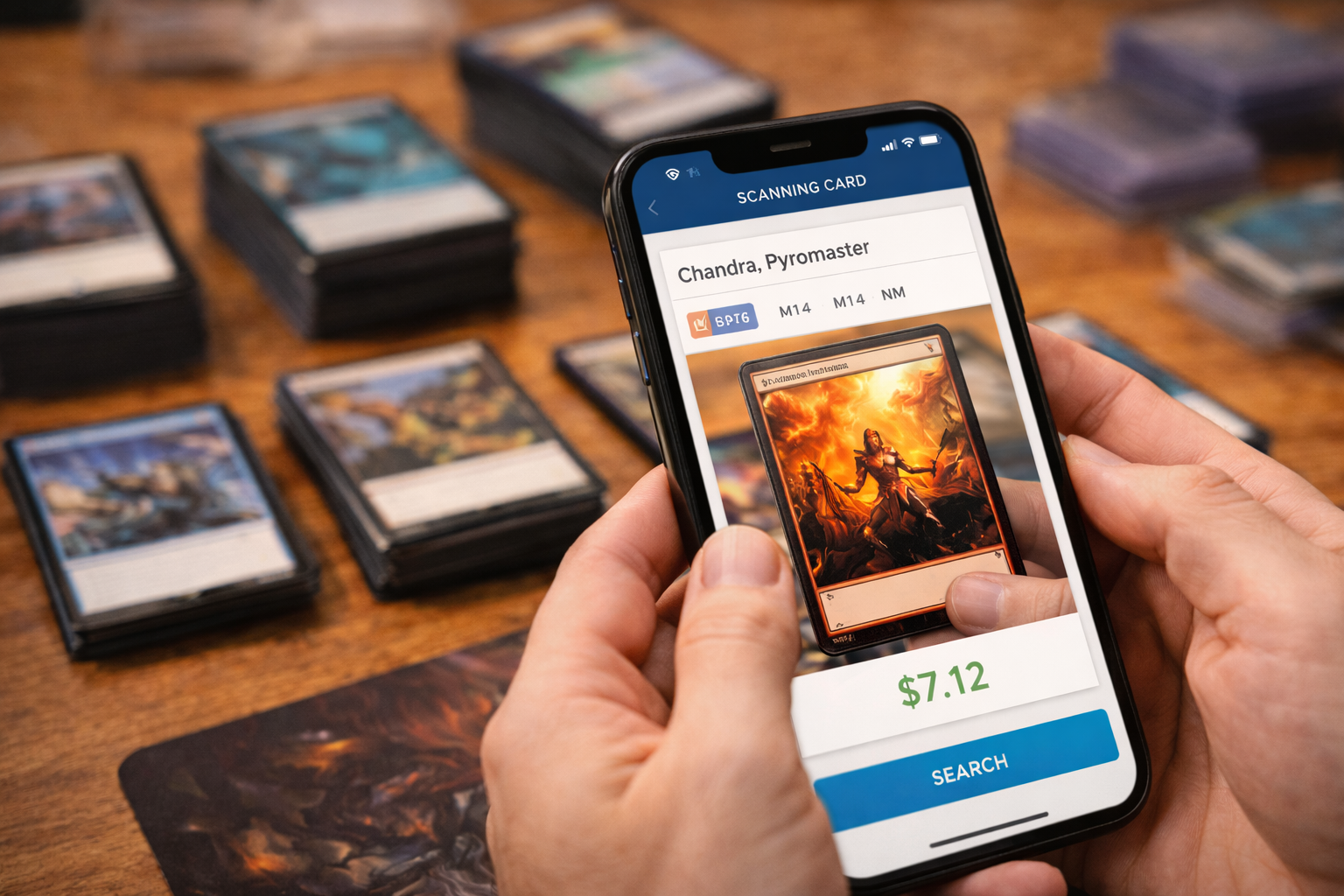
The TCGplayer app has a built-in card scanner that ties directly into their marketplace pricing. It is a solid option if TCGplayer is your primary pricing reference. The collection tracker updates automatically when you buy cards through the platform, which is a nice touch if you use TCGplayer for both buying and selling.
Price: Free Best for: Price checking against TCGplayer market data Platforms: iOS and Android
CardCastle
CardCastle offers a clean interface with card scanning, collection management, and export-to-spreadsheet functionality. Users consistently praise it for being well-designed and easy to use. If you have a large collection you want to catalog over time, CardCastle is a strong choice.
Price: Free with premium features Best for: Long-term collection management and cataloging Platforms: iOS, Android, and Web
How to Sell What You Find
Alright, you have bought your bulk, picked through it, and found some value. Now what? Here are the most practical ways to turn those finds into actual money.
List Individually on eBay ($3+ Cards)
For any card worth $3 or more, listing it individually on eBay gives you the best return. eBay's audience for MTG singles is massive, and Buy It Now listings with free shipping via eBay Standard Envelope (ESE) are the standard approach. The challenge is that creating individual eBay listings is tedious. One card might take 5 to 10 minutes to list manually between photos, item specifics, categories, and descriptions.
This is exactly why I built MTG Bulk Caster. If you already have your cards scanned into Manabox, Moxfield, or Archidekt, you can export a CSV and import it directly into MTG Bulk Caster. The tool matches each card against its database, pulls images, maps eBay categories, and fills in item specifics automatically. Set your pricing rules, export an eBay-compatible CSV, and bulk upload. What would take an entire weekend of manual listing can be done in minutes.
Best for: Cards in the $3 to $10 range that are too valuable for buylists but too numerous to list by hand.
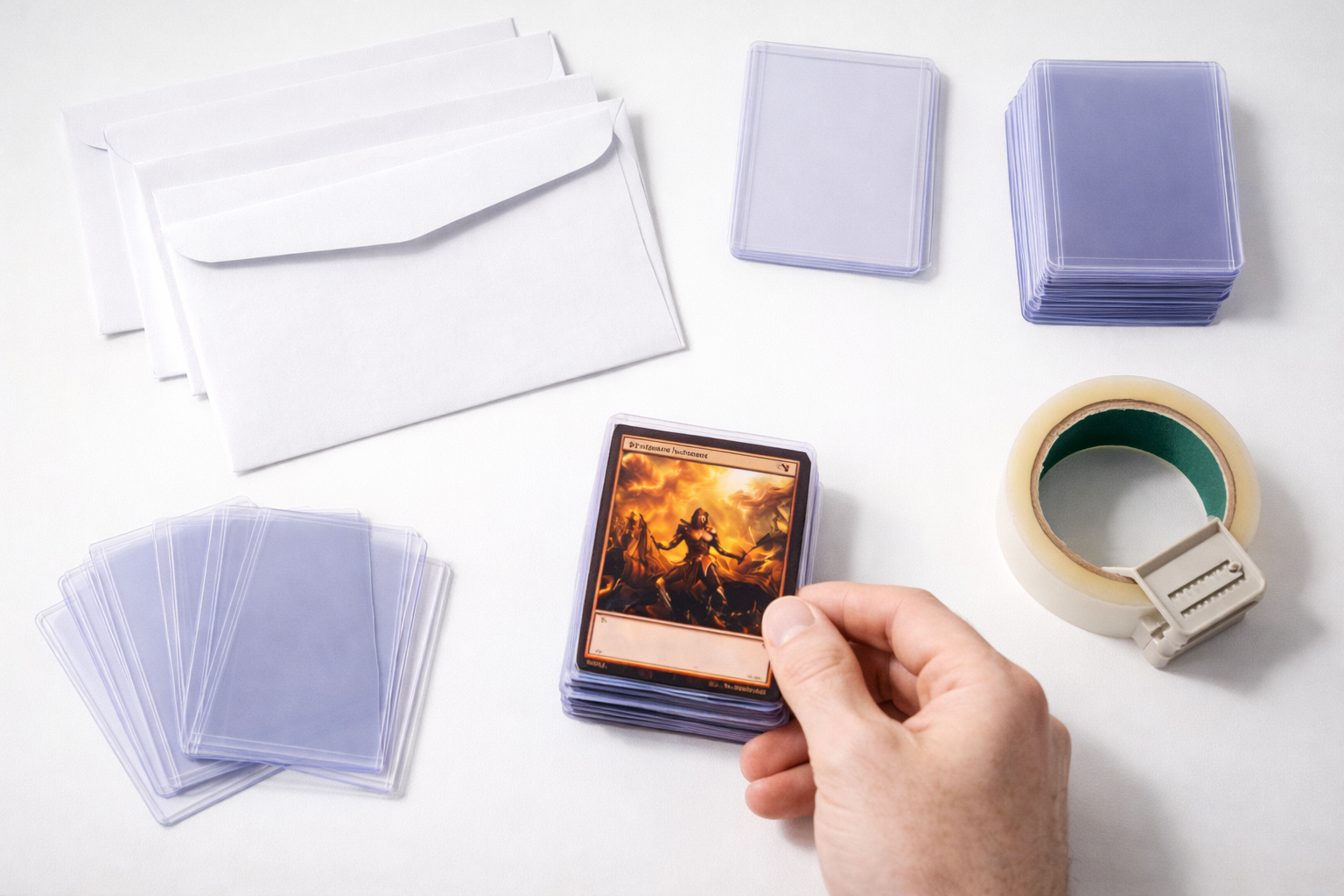
When you are ready to ship those sales, make sure you are using the right supplies. I put together a guide on the best top loaders for shipping trading cards on eBay that covers exactly what you need.
Sell to Buylists ($1+ Cards)
If you do not want to deal with listing and shipping individual cards, buylists are the fastest path to cash. Card Kingdom, Star City Games, and ChannelFireball all maintain active buylists. The trade-off is that buylist prices are typically 40% to 60% of retail value. You get speed and convenience at the cost of margin.
Card Router is a free optimization tool that compares buylist prices across multiple vendors and tells you exactly where to send each card for the highest payout. Users report getting 20% or more above what they would earn from a single vendor's buylist.
Card Conduit takes a different approach. You ship your cards to them, and they handle the sorting, grading, and buylisting on your behalf. Fees range from 2% (sorted service) to 10% plus $0.03 per card (standard service). It is a great option if you value your time more than maximizing every last dollar.
Beat the Buylist is another comparison tool worth bookmarking. It lets you search specific cards or entire sets and see which vendors are currently offering the best buylist prices.
Sell as Playsets or Small Lots ($0.50 to $3 Cards)
Cards in the $0.50 to $3 range often are not worth the effort of listing individually, but they are too valuable to throw back in the bulk box. Grouping them into playsets (sets of four copies) or themed lots (all the good commons from a specific set, for example) and listing those on eBay can be an efficient middle ground. A playset of a $1 uncommon listed for $5 with free shipping is a quick, easy sale.
Sell True Bulk Back to Vendors or Other Buyers
After picking out everything of value, you will still have a mountain of cards left. True bulk commons and uncommons can be sold back to vendors at $3 to $5 per 1,000 cards, or resold on Facebook Marketplace and eBay at $5 to $10 per 1,000. Some LGS locations buy bulk back as well. You will not get rich on this step, but it recovers some of your initial investment and clears space.
Donate What You Cannot Sell
If you have picked your bulk clean and the rest truly has no market value, consider donating cards to your LGS for new-player welcome kits, to after-school programs, or to community centers. It is a good way to give back and get a pile of cardboard out of your living space.
The Math on Flipping Bulk for Profit
Let me walk you through a realistic example of what buying and flipping a bulk lot looks like.
You buy 5,000 unsorted commons and uncommons from Facebook Marketplace for $20 (about $4 per 1,000). After sorting, you find:
-
8 cards worth $3 to $5 each (eBay value after fees: ~$25)
-
15 cards worth $1 to $3 each (sold as playsets/lots: ~$18)
-
40 cards worth $0.25 to $1 each (buylisted in a batch: ~$8)
-
4,937 remaining true bulk cards (sold at $5 per 1,000: ~$25)
Total revenue: ~$76 Total cost: $20 (cards) + $5 (shipping supplies) + $3 (stamps) = $28 Profit: ~$48 Time invested: 3 to 4 hours of sorting and listing
That works out to about $12 to $16 per hour, which is solid for something you can do while watching TV. The numbers get better as you get faster at sorting and develop an eye for which cards carry value.
The tool that makes the biggest difference in this workflow is how you list the $3 to $10 cards on eBay. Manually, those 8 cards would take an hour or more to list. With MTG Bulk Caster, you can have them listed in minutes using the CSV workflow. That time savings alone can double your effective hourly rate.
Common Mistakes When Buying Bulk MTG Cards
Paying too much per thousand. If you are buying bulk for resale purposes, anything over $5 per 1,000 for unsorted commons and uncommons starts eating into your margins. Know your numbers before you negotiate.
Buying already-picked bulk. Bulk from a store or experienced reseller has usually had all the value cards removed. Focus on buying from individuals, estate sales, and players who are exiting the game. These sources are more likely to contain unpicked value.
Not checking commons and uncommons. Skipping the commons and uncommons during your sorting pass is leaving money in the box. As I covered above, there are dozens of commons and uncommons in current Standard alone that are worth $2 to $7 each.
Ignoring condition. A Near Mint Spelunking is worth $3. A Heavily Played one buylists for a fraction of that. Pay attention to card condition when sorting, and be honest about grading when you sell.
Hoarding instead of selling. Bulk loses value over time as reprints happen and formats rotate. Sort it, sell it, reinvest. Do not let it sit in your closet for two years while the prices decline.
Frequently Asked Questions
How much should I pay per 1,000 when I buy bulk MTG cards?
The community standard for unsorted commons and uncommons is $3 to $5 per 1,000 cards. Bulk rares typically go for $0.03 to $0.10 each. Anything significantly above these ranges should come with guarantees about card quality, set diversity, or included rares.
Is buying bulk MTG cards on Amazon worth it?
For new players looking for a pile of cards to learn with, Amazon lots are fine. For resellers, Amazon bulk is overpriced (often $15 to $25 per 1,000) and heavily picked. You will find much better deals on Facebook Marketplace, eBay, or at local sales.
What apps can I use to scan and price check bulk magic cards?
Manabox, Delver Lens, the TCGplayer app, and CardCastle all offer card scanning with real-time pricing. Manabox is the most popular option and supports CSV exports, which is useful if you plan to list cards on eBay using a bulk listing tool like MTG Bulk Caster.
Can you actually make money buying and reselling bulk magic cards?
Yes, but it depends on your sources and your process. Buying unpicked bulk from individuals at $3 to $5 per 1,000 and then sorting out the value cards is a proven side-hustle strategy. Realistic profit margins range from $10 to $20 per hour of sorting and listing time once you develop an efficient workflow.
What are the most valuable commons and uncommons to look for in bulk?
Commander staples (Swords to Plowshares, Vandalblast), Pauper format staples, competitive crossover cards (Spelunking, Into the Flood Maw, Stock Up), "any number" cards (Hare Apparent, Cid Timeless Artificer), old-border foils, and anything from limited-print-run sets like Portal Three Kingdoms are consistently valuable despite their rarity.
Where is the best place to buy bulk magic cards for building decks on a budget?
Your local game store's bulk bins are the best starting point for budget deckbuilders. You can cherry-pick the exact cards you need at $0.10 to $0.50 each. For larger quantities, Facebook Marketplace and eBay lots give you the most cards per dollar.
How do I sell the valuable cards I find in bulk lots?
Cards worth $3 and up should be listed individually on eBay for the best return. Cards worth $1 to $3 can be buylisted or sold as playsets. MTG Bulk Caster lets you import your scanned collection directly into eBay-ready listings, cutting listing time from hours to minutes. For buylisting, Card Router compares prices across vendors to maximize your payout.
Author Bio
Jake is the founder of MTG Bulk Caster, a Magic: The Gathering player, and a top-rated eBay seller who has processed thousands of bulk cards into individual listings. He built MTG Bulk Caster after spending one too many weekends manually typing card names into eBay and decided there had to be a better way. When he is not sorting bulk, he is probably losing to someone's Krenko deck at his LGS.
Some links in this article are affiliate links. If you buy through them, BulkCaster may earn a commission at no additional cost to you, and it helps keep our tools free. Thank you for the support.