
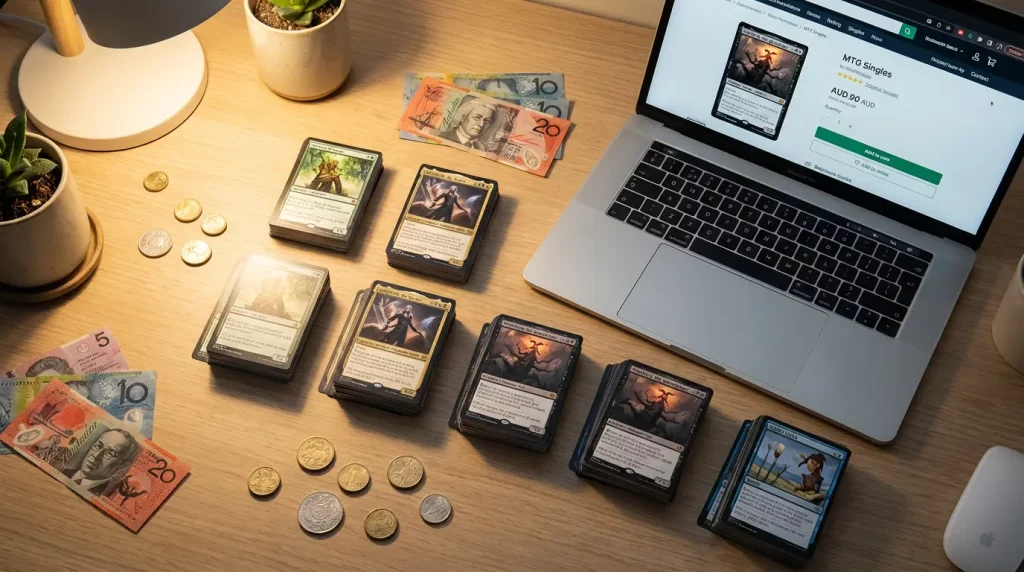
If you want to sell MTG cards in Australia, you’re in a better position than you probably think. Most selling guides out there are written from a US perspective. They assume you have access to TCGplayer, USPS flat-rate shipping, and a buyer pool that thinks $1.50 is a reasonable card price. That’s great if you’re stateside, but here in Australia, we don’t have TCGplayer at all and we’re playing a completely different game.
I’ve been selling Magic: The Gathering singles on eBay from Australia for years. I’ve shipped thousands of cards, figured out what works (and what doesn’t), and built a workflow that lets me list 500 to 1,000 cards in a single session. This guide breaks down the exact process I use, from scanning to shipping, and explains why the Australian market is more profitable than most people realize.
Why Australia Is Actually a Great Market for Selling MTG Singles
Here’s something that surprises most people when they first hear it.
TCGplayer does not serve Australia. We can’t sell on it, and as of right now, we can’t buy from it either. There are rumors circulating that TCGplayer may open up to Australian buyers before too long, but as of writing, the platform is completely off-limits.
Now, Australian buyers do have some options. You can order from Card Kingdom if you’re willing to pay international shipping. You can visit your local game store. And there’s MTGMate, which is essentially Australia’s version of Card Kingdom. But each of these has real limitations that work in your favor as an eBay seller.
LGS supply is the big one. Australia is enormous, and card supply is spread thin. Even within a major capital city, you can check every store in town and not find the specific card you need. That’s not a sometimes problem. It’s an all-the-time problem. Walk into three shops in Sydney looking for a specific uncommon from a set that’s two years old and you’ll understand what I mean.
MTGMate fills some of that gap, but they tend to charge a premium on pricing and their shipping starts at $6 minimum. If you want tracking, it’s $10. When you’re buying a $4 card, paying $6 to $10 in shipping on top feels rough. That’s where eBay sellers with competitive pricing and $2.10 untracked shipping have a massive edge.
The result is that eBay.com.au is where most Australian buyers end up when they need specific singles at reasonable all-in prices. Less competition plus limited local supply plus expensive alternatives equals higher prices for you as a seller.
I typically price my cards at TCGplayer market price converted to AUD, then add roughly 20% on top. And they sell consistently. That is not a typo. Because Australian buyers can’t access TCGplayer and the local alternatives are either limited in stock or come with steep shipping fees, eBay.com.au has developed its own pricing ecosystem. It trends higher than the US equivalent. Once I figured this out, the entire business model clicked into place.
If you’re sitting on binders of Magic cards and you’ve been assuming that selling singles isn’t worth the effort because “everything costs more in Australia,” flip that logic around. Your buyers are dealing with limited local stock, expensive shipping from dedicated stores, and no TCGplayer. They’re willing to pay competitive local prices for the convenience of domestic eBay shipping and actual card availability.
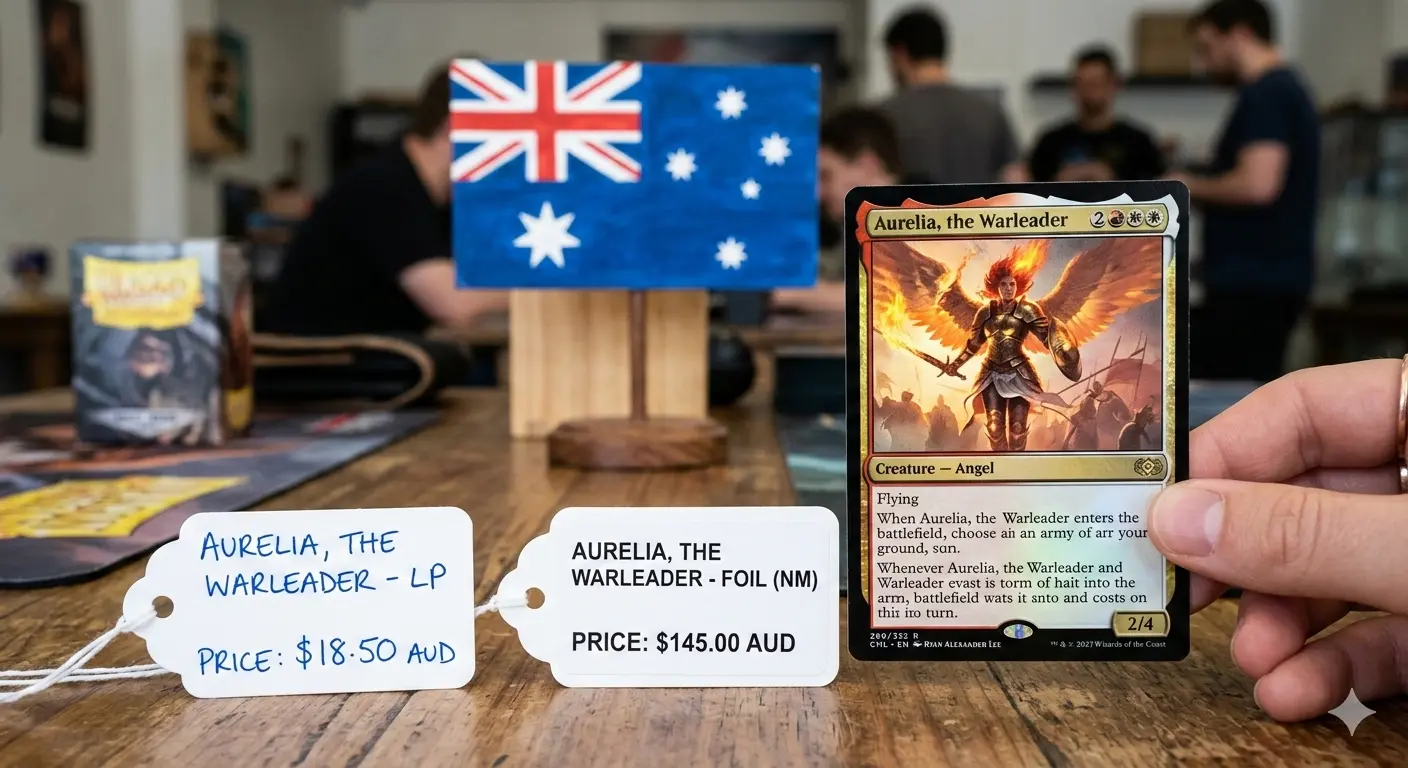
Step 1. Scan Everything Into a Collection App
The first step to sell MTG cards in Australia efficiently is getting your collection into a digital format. I use Manabox for phone camera scanning, and it handles about 95% of cards without issues. If you’ve already got a collection logged in Moxfield, that works too.
I do the scanning in batches while watching TV. It’s brainless work once you get a rhythm going. The key here is building a digital inventory where every card has its set, condition, and foil status recorded. That data is what powers the entire listing process later.
If you’re brand new to collection scanning and want a detailed walkthrough, I wrote a full guide on turning your Manabox collection into eBay listings that covers the export process step by step.
Step 2. Sort Your Cards Into Tiers
Not every card deserves the same treatment. Because Australian postage has a higher floor than the US, the value tiers look a bit different here.
$50+ AUD cards. These get individual photos, careful condition descriptions, and manually created listings. This is where taking your time pays off. Buyers spending this much reasonably want to see the exact card they’re getting.
$3 to $50 AUD cards. Worth listing individually, but not worth photographing each one. This is the bulk listing sweet spot. Stock images work perfectly here, and I’ve sold thousands of cards this way with no issues. The key is being honest about condition. More on that below.
$1 to $3 AUD cards. Playsets grouped by color, set, or theme. A playset of a $2 card listed at $7 plus shipping works. Four individual listings of a $2 card does not. Anything MP or worse in this range, I just don’t bother with. The margin isn’t there and the return risk isn’t worth it.
Under $1 AUD. If you want to move these, job lots are the way to go. Sell them by the hundred or thousand and don’t overthink it.
The $3 to $50 range is usually the biggest pile, and it’s where the most money is hiding. These are cards that are too valuable for buylist prices (where you’d get roughly 50% of retail) but not valuable enough to justify 5 to 10 minutes of manual listing per card. This is what I call the “$2 Card Problem,” and solving it is the whole reason I built MTG Bulk Caster.

Step 3. The Listing Process (Where Most People Get Stuck)
Listing cards one by one on eBay is painfully slow. Each card needs the right category, item specifics (set name, rarity, condition, language, foil status), a title, and a price. Manually, that’s 5 to 10 minutes per card. If you have 300 cards in your $3 to $50 pile, that’s 25 to 50 hours of data entry. Nobody wants to do that.
Full disclosure: I built a tool to solve this exact problem. MTG Bulk Caster takes the CSV export from your collection app and generates a complete eBay-ready file with all the item specifics, categories, and stock images filled in automatically. You set your own pricing rules (markup multipliers, minimum prices, foil adjustments), and the tool applies them across your entire batch. I’d recommend checking over each card’s price before uploading to make sure your pricing rules are hitting local AU market rates consistently. Once you’re happy with everything, you upload the file to eBay and you’re done.
With this workflow, I can get 500 to 1,000 listings up per hour. That’s not an exaggeration. What used to be an entire weekend of listing is now a couple of hours.
If you’d rather not use a tool, you can build your own eBay File Exchange CSV templates manually, or use eBay’s Scan to List feature in the app. They all work. They’re just significantly slower in my experience.
Step 4. Pricing for the Australian Market
This is where a lot of Aussie sellers either leave money on the table or don’t realize the opportunity they’re sitting on.
Don’t just convert TCG Low to AUD and call it a day. The Australian market supports higher prices because TCGplayer is completely inaccessible here, LGS stock is limited, and the main online alternative (MTGMate) charges a premium plus $6 to $10 shipping. I price at TCGplayer market converted to AUD plus roughly 20%, and cards move consistently at that rate.
Use eBay.com.au sold listings to validate your prices. Filter by sold items, sort by recent. This tells you what Australian buyers are actually paying. You’ll often find it confirms that AU pricing sits above the US equivalent.
Set a minimum price floor. Factor in your postage and packing costs before deciding what’s worth listing. I won’t list anything individually below about $3 to $4 AUD. Below that threshold, it goes into a bundle or a lot. And anything MP or worse under $3 just gets skipped entirely. The margin is too thin to justify the return risk.
Step 5. Be Honest About Condition (This Is Not Optional)
This is the thing that will make or break you when you sell MTG cards in Australia, especially when you’re using stock images instead of photos. Stock images are fine for cards under $50. Buyers expect them. But if you list a card as NM and it shows up LP, you’ll get a return, a negative, or both. And honestly, you’ll deserve it.
Grade conservatively. If you’re not sure whether a card is NM or LP, call it LP. The buyer gets a pleasant surprise instead of a dispute. I skip anything MP or worse in the sub-$3 range entirely. The margin is too thin to justify the hassle.
The stock image plus honest grading combination works. I’ve sold thousands of cards this way and my feedback reflects it. But the moment you start fudging condition grades to squeeze out a few extra dollars, the entire system falls apart. For a deeper look at how condition grading affects your shipping and packaging choices, check out our guide on the best top loaders for shipping trading cards on eBay.
Step 6. Shipping From Australia
Australia Post is the main option, and here’s exactly how I handle it.
Untracked letters. Roughly $2.10 AUD all-in including packing supplies. Card goes in a penny sleeve, into a top loader, into a team bag, into the envelope. I use untracked for the majority of sales under $20 AUD. It’s been very reliable. Across thousands of orders, I’ve only had 4 or 5 go missing entirely. At that loss rate, the savings on tracked postage more than make up for the occasional replacement.
Tracked letters. Roughly $6 AUD all-in ($5.40 for a tracked envelope plus packing supplies). I use this for anything over $20 AUD, or if the buyer specifically requests tracking.
High-value cards ($100+ AUD). Tracked and signed for. Non-negotiable.
Combine shipping aggressively. Always offer it. Mention it in every listing. A buyer grabbing 5 cards at one combined shipping rate is far more profitable than 5 separate sales. Buyers love it, and it dramatically improves your margins. MTG Bulk Caster lets you set a global description that gets added to every listing, so you can include your combined shipping offer once and have it appear across all your cards automatically.
One more tip: buy your top loaders, team bags, penny sleeves, and padded mailers in bulk online. The markup at Officeworks or your LGS for packing supplies is painful compared to ordering a box of 200 from an eBay supplier.

Step 7. Automate Your Buyer Communication
This is a small touch that has made a noticeable difference to my feedback rate. I set up a Zapier automation on the free tier that sends buyers a message after each sale. It checks for new sales every 10 minutes, so the buyer gets a message within minutes of purchasing, but at a slightly random interval each time. It doesn’t feel automated because the timing is never exactly the same.
The message is simple. Just a quick “thanks for the order, here’s what to expect with shipping” note. Nothing pushy, just good communication. The improved rate of positive feedback compounds over time. More feedback means more buyer confidence, which means more sales.
The Numbers
On a good session, I’m scanning, sorting, and listing 500 to 1,000 cards per hour from the $3 to $50 tier. No photos needed, just stock images and honest condition grading. Cards over $50 take longer individually because I’m photographing them, but there are fewer of those. True bulk I can lot up in an evening.
At TCG market plus 20% pricing with $2.10 untracked shipping, the margins are solid when you sell MTG cards in Australia. I think a lot of AU-based players assume selling singles isn’t worth it because “everything’s more expensive here.” But your buyers are dealing with thin LGS stock, premium pricing from dedicated online stores, and no TCGplayer access. They’re already used to paying more, and your eBay listing with cheap domestic shipping is genuinely the best deal they can find.
If you’ve been sitting on boxes of Magic cards and waiting for a reason to start listing them, this is it. The tools exist, the market is there, and the math works out better than most people expect.