
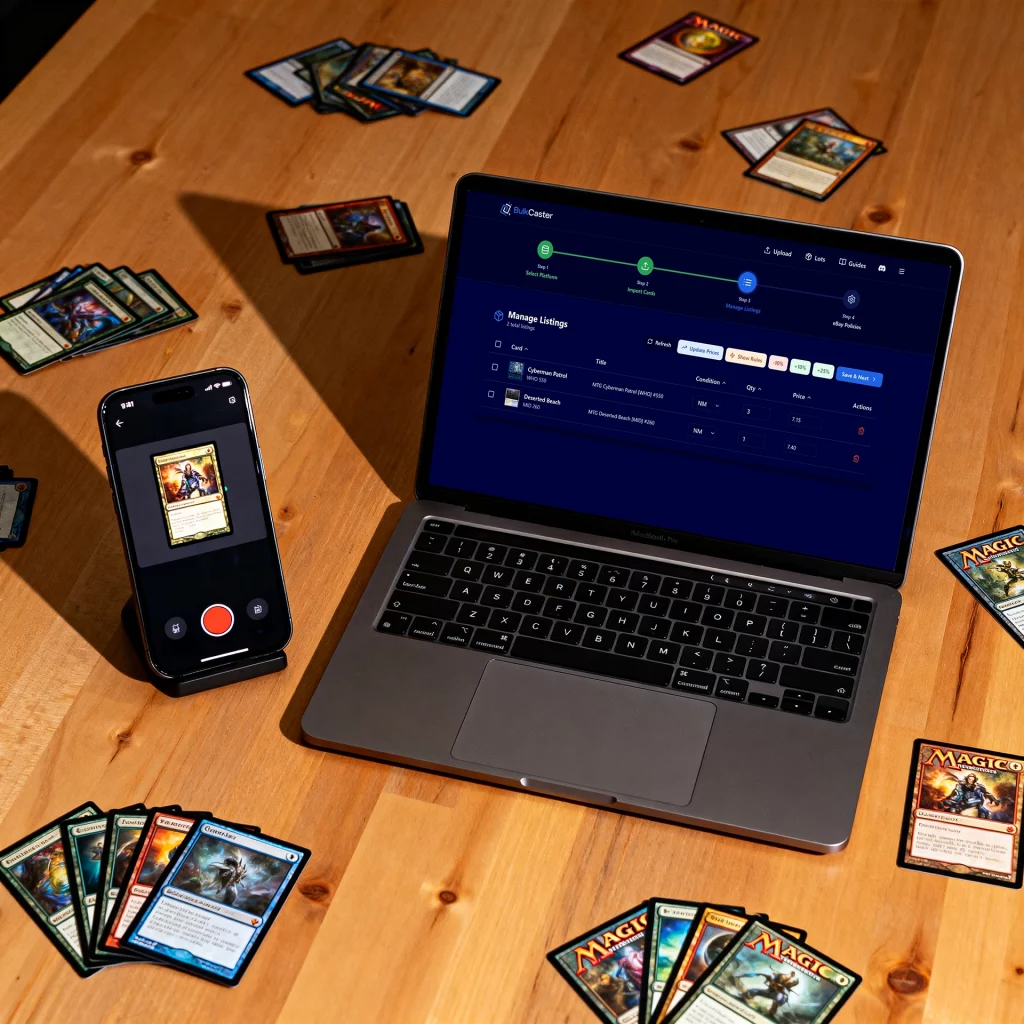
Going from Manabox to eBay should be simple. You’ve already done the hard part.
Seriously. If you’ve spent the last few weekends scanning your Magic: The Gathering collection into Manabox, card by card, binder by binder, you’ve already done the work that most sellers never bother with. Your collection is digitized. You know exactly what you have. You’ve even got set editions, conditions, and market prices sitting right there in the app.
So why are those cards still sitting in a box under your desk?
I know why. Because the next step feels like a wall. Taking that organized digital collection and actually turning it into eBay listings means hours of repetitive data entry: looking up each card, finding photos, writing titles, setting prices, configuring shipping. Do that for 200 cards and you’ve lost an entire weekend. Do it for 500 and you’ve lost your mind.
Here’s the thing nobody tells you: there’s a bridge from Manabox to eBay, and it takes about 10 minutes to cross. Let me show you how.
What is Manabox (and Why It Matters for Selling)?
If you’re reading this, you probably already know Manabox. But let me explain why it’s such a big deal for sellers specifically, not just collectors and deck brewers.
Manabox is a free MTG companion app that lets you scan your physical cards using your phone’s camera. Point it at a card, and the app identifies the exact printing, including set, edition, foil treatment, and variant. It pulls real-time pricing from TCGPlayer, Card Kingdom, Star City Games, and Cardmarket. And it organizes everything into binders and lists that mirror how you actually store your cards.
The scanning feature is genuinely impressive. Lock it to a specific set and you can rip through an entire booster box worth of cards in a few minutes. The app handles double-faced cards, showcase frames, extended art, and all the variants that make MTG pricing such a headache. Once scanned, every card sits in your digital collection with its set code, collector number, condition, and current market value attached.
For pure collecting, that’s the whole point. But for selling? That data is everything you need to go from Manabox to eBay. It’s just trapped inside an app that doesn’t talk to eBay.
Until now.

The $2 Card Problem Nobody Talks About
Before I walk through the actual process, let me talk about why this matters so much. Because if you’re only selling $20+ cards on eBay, you probably don’t need a bulk listing tool. You can take your time with those. The real money that most sellers leave on the table is in what I call the “$2 card zone.”
These are cards worth somewhere between $1 and $10. Too valuable to dump at buylist prices where you might get $0.20 on the dollar. But not valuable enough to justify spending 5 to 10 minutes manually creating an eBay listing for each one. At that rate, your effective hourly wage for listing drops below minimum wage pretty fast.
Here’s a quick example. Say you’ve got a Monastery Swiftspear from a recent set. It’s sitting at about $2 on TCGPlayer. Your local game store’s buylist might offer $0.30 for it. But on eBay, with the Standard Envelope shipping option (which costs under $1 for cards priced at $20 and below), you can sell it for $2.50 to $3.50 and actually make real money on it.
The problem has never been the demand. People buy $2 to $5 MTG singles on eBay all day long. The problem is the time it takes to get them listed. If it takes you 8 minutes per card and you’ve got 300 of these mid-value cards sitting in your collection, that’s 40 hours of listing. A full work week. For cards worth $2 each.
That’s the problem MTG Bulk Caster was built to solve. It turns the Manabox to eBay gap from a 40-hour nightmare into a lunch break.
How to Go From Manabox to eBay (Step by Step)
Here’s the actual Manabox to eBay workflow. It’s simpler than you’d expect.
Step 1: Export Your Collection From Manabox
Open Manabox and navigate to the binder or list you want to sell. The app lets you export your collection as a CSV file. This CSV contains all the data you’ve already captured: card names, set codes, collector numbers, quantities, conditions, and prices.
A quick tip to speed up your Manabox to eBay process: organize the cards you want to sell into a dedicated binder within Manabox before exporting. Call it “To Sell” or “eBay Batch 1” or whatever works for you. That way you’re not exporting your entire 5,000-card collection when you only want to list 200 of them.
Step 2: Import Into MTG Bulk Caster
Head to MTG Bulk Caster and upload your Manabox CSV. The tool reads the file and matches each card against its database. It pulls in high-quality card images automatically (no more screenshotting Scryfall), maps each card to the correct eBay category, and starts building your listings.
This is where the Manabox to eBay pipeline really clicks. What would normally require you to manually search for each card, find a photo, write a title, set a category, and configure item specifics is handled automatically. The tool also works with exports from Archidekt and Moxfield, so if you track your collection across multiple platforms, you’re covered.
Step 3: Set Your Pricing Rules
MTG Bulk Caster fetches current market prices for every card in your import. But here’s the part that separates smart sellers from everyone else: you can set markup rules.
Maybe you want to price everything at 1.5x the TCG Low price. Maybe you want a flat $0.99 minimum so you’re not listing $0.15 commons that aren’t worth the stamp. Maybe you want to price foils differently from non-foils, or set higher margins on rares and mythics.
You configure your rules once, and they apply across your entire batch. No card-by-card price lookups. No mental math. No spreadsheet gymnastics.
Step 4: Review and Export to eBay
Before you export, you can review everything. Edit individual listings, adjust prices, remove cards you’ve changed your mind about. When you’re happy, hit export. MTG Bulk Caster generates an eBay-compatible CSV file with pre-configured listing policies, proper titles, images, categories, and item specifics already baked in.
Upload that CSV to eBay using their File Exchange or Seller Hub bulk upload tool, and your cards go live. Hundreds of listings. Minutes, not days.
The Math That Changed My Mind
I’ll be honest. When I first heard about bulk listing tools, I was skeptical. I figured the time I’d spend learning a new tool would eat up any time I’d save using it. I was wrong, and the math isn’t even close.
Manual listing on eBay: Let’s say you’re fast. Five minutes per card (finding the image, writing the title, setting item specifics, pricing, configuring shipping). For 200 cards, that’s roughly 16 to 17 hours of work.
Using the Manabox to eBay workflow through MTG Bulk Caster: Scanning 200 cards into Manabox takes about 30 to 40 minutes if you’re methodical. Exporting, importing, setting pricing rules, and reviewing takes another 15 to 20 minutes. Total time: under an hour.
That’s not a marginal improvement. That’s the difference between “I’ll get to it this weekend” and “I did it during my lunch break.”
And the revenue side is just as compelling. If your average card sells for $3 and you list 200 of them, that’s $600 in potential revenue. After eBay’s 13.25% final value fee (plus the $0.30 per-order fee on sales under $10) and shipping costs, you’re looking at around $400 to $450 in actual profit. From cards that were sitting in a box doing nothing.
Compare that to selling the same cards on a buylist, where you might get $60 to $80 for the whole lot.
Why eBay (and Not Just TCGPlayer)?
This is a question I get a lot, so let me address it head on.
TCGPlayer is great. It’s purpose-built for trading card sales and has a massive buyer base of Magic players. But it has a specific weakness that makes eBay more attractive for mid-value and bulk singles.
TCGPlayer charges a flat $0.50 fee per transaction on top of their percentage-based seller fees. On a $50 card, that $0.50 is nothing. But on a $2 card, it’s a 25% surcharge. That fee structure makes it really hard to profitably sell anything under $5 on TCGPlayer, and the platform even acknowledges this is a known limitation.
eBay’s fee structure, while not cheap (13.25% on trading cards plus a $0.30 per-order fee for sales under $10), is more predictable and generally more favorable for the $2 to $10 range. Combine that with eBay’s Standard Envelope shipping (under $1 with tracking included) and you’ll see why the Manabox to eBay route is such a profitable channel for cards that don’t make sense anywhere else.
Plus, eBay buyers aren’t exclusively MTG players. You’ll get casual collectors, people building cubes, EDH players looking for specific printings, and parents buying cards for their kids. It’s a broader market.
Common Questions About Going From Manabox to eBay
Does it handle foils and special variants correctly? Yes. If you’ve scanned the card correctly in Manabox (and the app is quite good at identifying showcase frames, borderless art, extended art, retro frames, and foil treatments), that data carries through the entire pipeline. MTG Bulk Caster uses the exact printing information to match photos and set pricing.
What about card condition? Manabox lets you set condition for each card when you scan it. If you’re diligent about marking cards as Near Mint, Lightly Played, or whatever the actual condition is, that information exports with your CSV and gets reflected in your eBay listings. This is important: accurate condition grading builds your seller reputation and reduces returns.
Can I use this with other collection apps? MTG Bulk Caster was designed with the Manabox to eBay workflow as its core use case, but it also supports imports from Archidekt and Moxfield. If you use a different app, check whether it can export to CSV. Most collection trackers can, and MTG Bulk Caster’s import is flexible enough to work with standard CSV formats.
Is MTG Bulk Caster free? There’s a free tier that lets you list up to 50 cards per month. That’s enough to test the workflow and see if it works for you. Paid plans start at $7.99/month for 500 cards and go up from there depending on volume. If you’re listing hundreds of cards regularly, the paid tiers pay for themselves pretty quickly.
What about eBay’s own bulk listing tools? eBay has been rolling out AI-powered listing tools, including their Scan-to-List feature and a newer “Magical Bulk Listing Tool.” These are useful for one-off listings, but they don’t integrate with collection apps like Manabox and they don’t offer the kind of batch pricing rules that make bulk selling profitable. If your cards are already in Manabox, using eBay’s native tools means re-scanning every single card from scratch.
Tips for Maximizing Your eBay MTG Sales
Once your cards are listed, a few small optimizations can make a big difference in how quickly they sell.
Use eBay Standard Envelope for everything under $20. This is the cheapest tracked shipping option available for trading cards. It costs under a dollar (currently around $0.74 for 1 oz), includes tracking, and qualifies you for Top Rated Seller status. The $20 per-item limit means it covers the vast majority of the mid-value singles you’ll be listing.
Write your listings to answer the buyer’s actual question. When someone searches “Monastery Swiftspear Foundations” on eBay, they want to see the set name, the card condition, and whether it’s foil. Make sure your titles include the card name, set name, condition, and any variant details. MTG Bulk Caster handles most of this automatically, but it’s worth reviewing a few listings to make sure the titles read well.
Price competitively but don’t race to the bottom. One advantage of selling on eBay instead of TCGPlayer is that you’re not in a constant price war with dozens of other sellers of the exact same card. eBay buyers are often willing to pay a small premium for a well-presented listing with good photos and fast shipping. A 1.3x to 1.5x markup over TCG Low is generally the sweet spot.
Batch your shipping. When orders come in, don’t run to the mailbox after every sale. Set a shipping schedule (daily or every other day), print all your labels at once, and drop everything off in one trip. This is where eBay’s batch shipping tools in Seller Hub really shine.
The Bottom Line
The Manabox to eBay pipeline doesn’t have to be painful. If you’ve already scanned your Magic: The Gathering collection into Manabox, you’re sitting on a goldmine of organized data. Every card name, set, condition, and price is already captured and ready to go. The only thing standing between that data and actual money in your pocket is a listing pipeline.
MTG Bulk Caster bridges that gap. It takes your Manabox export, adds market-based pricing, finds card images, generates proper eBay listing data, and spits out a CSV you can upload directly to eBay. The entire process takes minutes.
Those $2 cards? They’re not bulk anymore. They’re inventory.
Try MTG Bulk Caster for free and see how fast the Manabox to eBay process really is.
About Jake
Jake is the founder of MTG Bulk Caster and a lifelong Magic: The Gathering player who turned a hobby into a business. He runs a top-rated eBay store specializing in MTG singles, where he’s sold thousands of cards ranging from bulk commons to high-value chase rares. After spending one too many weekends manually creating eBay listings for $3 cards, he built MTG Bulk Caster to solve the problem he couldn’t find a tool for: getting cards from collection apps like Manabox onto eBay without losing his sanity (or his entire Saturday). When he’s not slinging cardboard, you can find him brewing jank EDH decks that absolutely should not work but somehow do.