
If you want to sell MTG bulk and actually make money doing it, the thing standing between you and a real side hustle isn’t the cards. It’s the workflow. Most sellers either give up too early because listing feels impossible, or they undercharge because they don’t understand where their money is going. This guide fixes both problems.
Here’s what you’ll be able to do by the end: source bulk at the right price, sort it without losing your mind, list it without manually entering every card, ship it without eating your margin, and know at a glance whether you’re actually profitable. Whether you’re just starting to sell MTG bulk or you’ve been doing it a while and want to tighten the operation, this covers the whole picture.
This is a realistic overview of how the whole operation works in 2026, covering every major platform, tool, and decision point you’ll hit along the way.
Step 1: Where to Find MTG Bulk Worth Selling
Before you can sell MTG bulk, you need something to sell. The good news is that bulk is everywhere. The key is finding it at a price that leaves enough room after fees and shipping.
Your own collection is the most obvious starting point. Old binders, forgotten deck boxes, and the storage tub from your kitchen closet. Anything you’re not playing and wouldn’t buylist for more than face value is fair game. This is free inventory.
Local game stores often have bulk bins priced at $3 to $10 per thousand cards. Some stores will negotiate if you’re buying a large volume. Worth asking, especially if you’re a regular.
Facebook Marketplace and local MTG groups are consistently underrated. People quit the game, move, have kids, and suddenly have a collection they want gone. Search “MTG lot,” “Magic cards bulk,” and “Magic collection” regularly. Patient buyers find bulk at $0.001 to $0.003 per card here on a routine basis.
Card shows and flea markets attract sellers who often don’t know exactly what they have. You can pick up mixed bulk with above-bulk cards scattered in at true bulk prices if you’re willing to dig.
eBay bulk lots on auction are another source. Search “MTG bulk lot” and filter by completed listings to see what actually sells and for how much. Auctions with low views sometimes close at very attractive per-card rates.
Cardsphere is worth checking to understand what stores are paying via buylists. If you can source below buylist rates, your margin is already confirmed before you list a single card.
Step 2: Sort and Organize Your Inventory
Disorganized inventory costs you money. One of the most overlooked parts of the decision to sell MTG bulk is that the sorting step directly determines how fast you can list and how few mistakes you make. You’ll lose cards, double-list, ship the wrong thing, and waste time hunting for a card you already sold. Sort before you list, every time.
The most practical system:
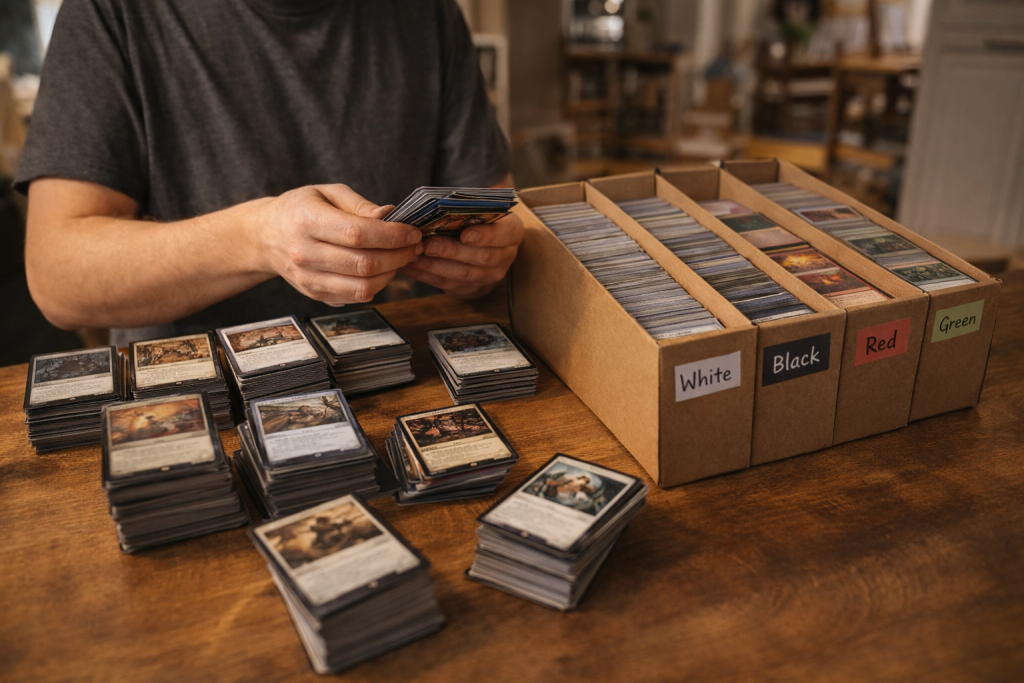
Tier by value first. True bulk (under $0.10 per card) goes in one pile. Above-bulk ($0.10 to $3.00) goes in another. Money cards ($3 and up) get their own section. You’ll handle each tier differently when it comes time to list and price.
Sort above-bulk by condition. Near Mint, Lightly Played, and Moderately Played sell at meaningfully different prices on eBay. Don’t mix conditions in a lot unless you’re disclosing it clearly in the listing title.
Catalog your inventory using a collection app. Manabox, Archidekt, and Moxfield all let you scan cards using your phone camera. The data goes into the app automatically, and each platform lets you export a CSV file when you’re ready to list. That CSV is what MTG Bulk Caster reads in Step 6 to generate your eBay listings automatically, without manual data entry. If you’re on Manabox and want to see the full end-to-end workflow before committing to it, this walkthrough covers every step from scan to live eBay listing.
Step 3: Decide Where to Sell MTG Bulk
There’s no single right platform. The best choice depends on your volume, how much time you have, and what cut you’re willing to give up. Here’s an honest look at every meaningful option.
eBay
eBay is the best platform for individual card listings in the $0.50 to $10 range. The buyer base is massive, buyers expect market pricing, and you have full control over your listings. Final value fees run roughly 13.25% on most trading card sales.
For bulk lots (commons and uncommons sorted by set), eBay works well. Buyers are hunting to fill collection gaps and are willing to pay $3 to $8 per hundred for sorted, readable lots. For individual above-bulk singles, eBay almost always beats any buylist rate if you can list efficiently.
The main limitation is listing time. Manually listing hundreds of cards takes hours. That problem is solvable with a bulk listing tool like MTG Bulk Caster (covered in Step 6), but it’s worth knowing upfront.
TCGPlayer
TCGPlayer is the competitive MTG singles marketplace. Pricing is transparent, buyer trust is high, and it’s where serious collectors go first.
The fee structure is the trade-off. TCGPlayer takes between 10.25% and 15.99% depending on your seller level, plus a $0.30 per-transaction fee. For cards priced at $0.50, that per-transaction fee alone eats 60% of the sale price. TCGPlayer becomes worthwhile at $3 and up where the flat fee is a smaller slice of the total.
Direct program sellers get better rates, but you need consistent sales volume to qualify.
Facebook Marketplace and Local MTG Groups
Facebook is genuinely useful for moving large lots quickly with zero fees. Local MTG groups exist in most cities. You set a price, someone messages you, you meet at an LGS or ship with PayPal Goods and Services for protection.
The downside is that you’re negotiating one deal at a time instead of setting prices and waiting for buyers to find you. Good for fast cash. Not the right tool for methodical bulk selling.
Buylist Services
<a href=”https://www.cardrouter.com/” rel=”nofollow noopener” target=”_blank”>Card Router</a> helps you find the best buylist prices across multiple stores simultaneously. If you want money today and don’t want to wait for sales to trickle in, buylists are the right call. The trade-off is real: buylist rates typically come in at $0.10 to $0.20 on the dollar compared to retail. You’re leaving value on the table in exchange for speed and zero listing work.
Card Conduit is a consignment model. You send them your cards. They grade, list, and sell them on your behalf, taking 10% of sales. There’s no upfront cost, and you get more than a buylist would pay. The downside is that you give up control and the money arrives over weeks as cards sell rather than all at once.
For sellers who want a hybrid approach: use buylists for true bulk under $0.10 per card, consign mid-value cards through Card Conduit, and list your above-bulk singles yourself on eBay.
CardMarket
CardMarket is the dominant MTG singles platform in Europe. If you’re based in the EU or UK, it has a large buyer base, competitive fees, and built-in bulk lot functionality. For North American sellers, it’s less relevant but worth knowing exists.
TCG Automate
<a href=”https://tcgautomate.com/” rel=”nofollow noopener” target=”_blank”>TCG Automate</a> is a scanner-based listing tool that works across multiple TCGs. It’s built for higher-volume operations and starts around $50/month. You scan cards physically using hardware, and the tool builds eBay and TCGPlayer listings from the scan data. Better suited to stores or full-time sellers than casual bulk operations.
If you’re already cataloging your cards in Manabox, Moxfield, or Archidekt, MTG Bulk Caster achieves the same result without any hardware. You export a CSV from the collection app you’re already using and run it straight through. No scanner, no device, no setup cost beyond the subscription.
Step 4: Price Your MTG Bulk Without Overthinking It
Pricing is the step where a lot of people either leave money on the table or price themselves out of sales entirely. When you sell MTG bulk, you’re usually working with large numbers of cards at low individual prices, so getting the framework right matters more than agonizing over any single card. Keep it simple:
- True bulk lots (commons/uncommons mixed): $3 to $5 per thousand
- Bulk rares: $0.10 to $0.25 each, or batch into lots of 25 for $5 to $8
- Above-bulk singles ($0.25 to $3): price at TCG Low minus 5 to 10% to sit below the current stack
- Money cards ($3 and up): check both TCG Low and recently completed eBay sold listings to see what buyers are actually paying, not just what sellers are asking
The completed listings filter on eBay is one of the most useful tools in the seller’s toolkit. TCG Low tells you what people are asking. Sold listings tell you what people paid. When those numbers diverge significantly, trust the sold data.
If you’re listing in volume, you don’t want to be hand-pricing every card individually. MTG Bulk Caster lets you set batch pricing rules: markup multipliers, minimum floors, and separate rules for foils vs. non-foils. You define the logic once and it applies across the entire batch when you export.
Step 5: Know Which Cards to Photograph and Which Ones to Skip
You don’t need to photograph every card. Knowing when to take real photos and when to use stock images saves a surprising amount of time.
Use stock images for: any card under $3, NM cards from widely available sets where your copy looks exactly like the stock image, and bulk lots where individual card photos aren’t practical. When you’re processing cards through MTG Bulk Caster, stock images are pulled automatically for each card matched from your CSV, so you’re not hunting for images manually either.
Take real photos for: any card priced above $3, cards with visible wear or damage, foils, promos, and alternate art printings, and any card where a buyer might feel misled by a generic stock image.
A good rule of thumb: if the card’s condition or appearance could reasonably differ from what the stock image shows, photograph it. If it’s a $0.75 common in clean condition that matches the stock image exactly, your time is worth more than the photo.
For bulk lots, one clear photo of a spread-out sample of the lot is enough. Use natural light, show the cards clearly, and let buyers see the mix.
Step 6: List Your Cards Without Manual Data Entry
This is where most people who try to sell MTG bulk give up. Manual eBay listing takes 4 to 6 minutes per card when you’re doing it properly: searching for the right title, entering the set and collector number, selecting the category, uploading a photo, setting the price, and saving. On 200 cards, that’s over 16 hours of work before you’ve sold a single thing.
The smarter approach uses the inventory you cataloged in Step 2. Export your CSV from Manabox, Archidekt, or Moxfield and run it through MTG Bulk Caster. The tool reads the CSV, matches each card to its database, pulls card images automatically, maps the correct eBay categories and item specifics, and applies your pricing rules in batch. You export an eBay-ready CSV and upload it directly.
Plans start at $7.99/month for 500 cards. There’s a free tier for 50 cards if you want to run through the workflow before paying anything.
This is specifically what closes the gap that makes above-bulk cards worth listing. Cards at $1 to $3 aren’t worth 5 minutes of manual listing time each. They are worth 30 seconds of bulk processing time.
For a detailed walkthrough of the Manabox-to-eBay workflow specifically, this guide covers every step: How to Turn Your Manabox Collection Into eBay Listings in Minutes.
If you’re not using a collection app and prefer physical scanning, <a href=”https://tcgautomate.com/” rel=”nofollow noopener” target=”_blank”>TCG Automate</a> (covered above in Step 3) is the main alternative for scan-based listing.
Step 7: Package and Ship MTG Cards Without Eating Your Margin
Shipping errors are the fastest way to get negative feedback and destroy your per-card margins. Keep the approach simple and consistent.
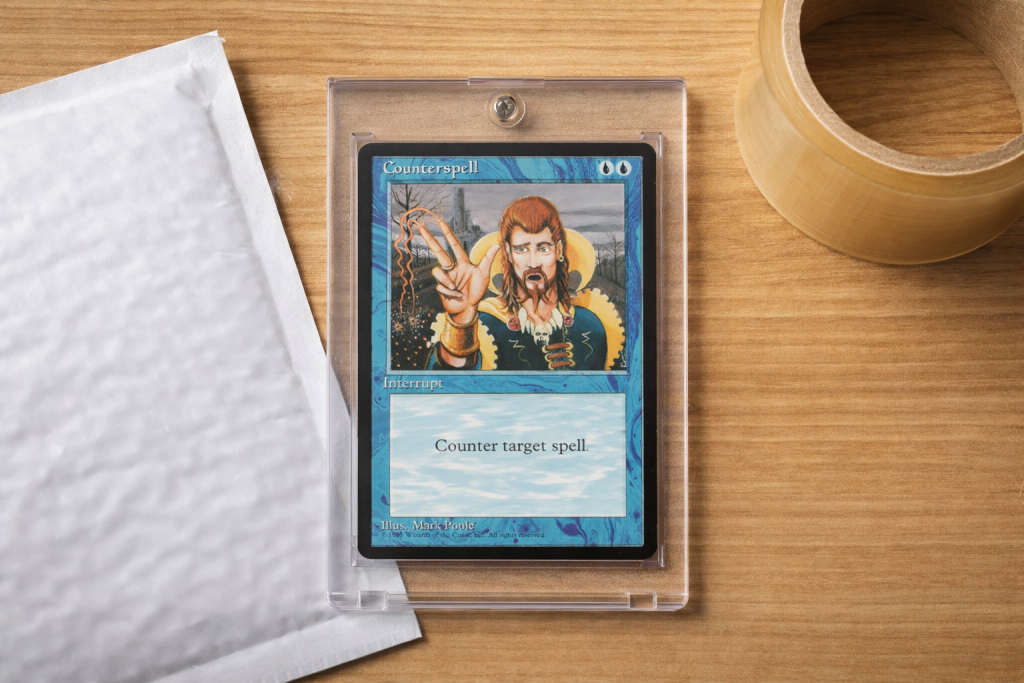
Cards up to $3: penny sleeve plus a team bag in a PWE (plain white envelope) works for NM cards going to buyers who aren’t worried about transit damage. The better option is eBay Standard Envelope (ESE) if you’re a qualifying seller, which caps out at $0.69 postage for a single standard card. For anything with value above $1, add a semi-rigid card saver or snap top loader inside the envelope.
Cards $3 to $20: penny sleeve plus top loader in a bubble mailer. Ship with USPS First Class with tracking. Don’t send cards in this range without tracking. A buyer saying they didn’t receive a $10 card is a dispute you will lose without it.
Cards over $20: double-bubble mailer or rigid cardboard sandwich, always with tracking, and consider signature confirmation for anything over $50.
Bulk lots: bubble mailer for lighter shipments, poly mailer for heavier ones. Anything over 1 lb may ship cheaper via USPS Priority Mail flat rate. Check both before printing the label.
For a detailed breakdown of top loader types and which ones make sense at different card values, the best top loaders for shipping trading cards guide covers every option with pricing.
Step 8: Track Costs vs. Sales So You Actually Know You’re Profitable
Running a profitable operation when you sell MTG bulk comes down to knowing your numbers. Most casual sellers assume they’re making money because sales are coming in. Then they look at their bank account and can’t explain where it went. A simple tracking system fixes that.
For every batch of cards you buy and list, track:
- Cost to acquire the cards (what you paid per card or per lot)
- Listing fees on eBay (insertion fees apply depending on your plan)
- Final value fees (roughly 13.25% on eBay per sale)
- Shipping cost per card or lot
- Packaging supplies (top loaders, penny sleeves, team bags, bubble mailers, labels)
- Subscription tools (collection apps, MTG Bulk Caster, any other software)
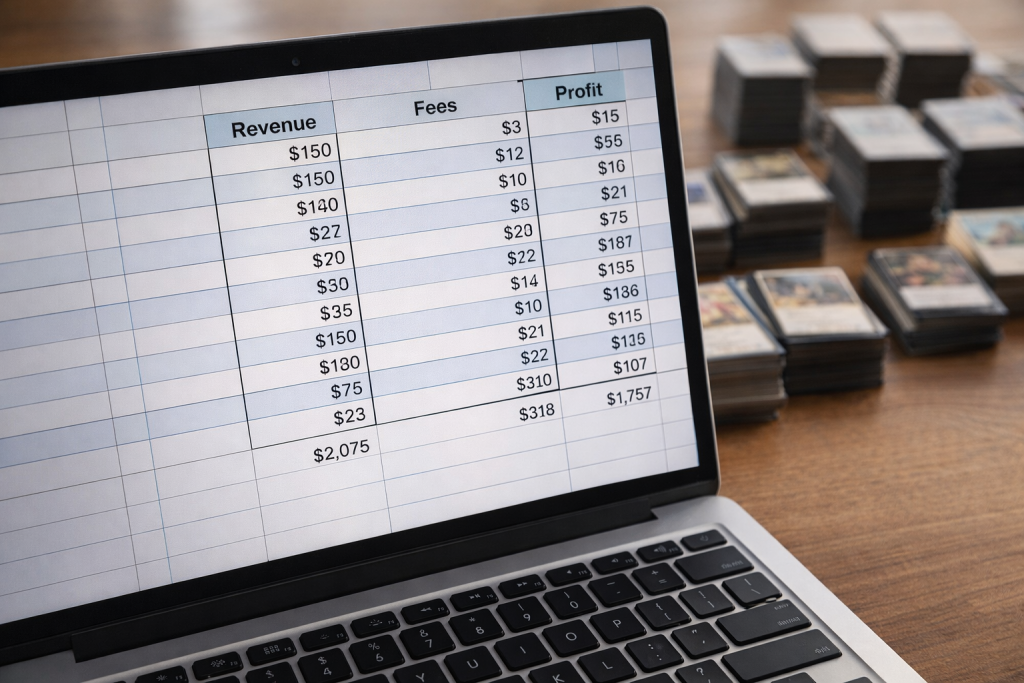
A five-column spreadsheet is enough: Revenue, Cost of Goods, Fees, Shipping, Profit. One row per batch or per selling period.
If your net profit after all costs on a $0.75 card is under $0.10, your margins aren’t sustainable. Either your source cost is too high, you’re absorbing shipping that should be charged to the buyer, or your fee math is off somewhere.
Step 9: Build Repeat Customers Without Being Annoying About It
Repeat buyers are the highest-leverage part of any eBay selling operation, and something most people overlook when they first start to sell MTG bulk. They already trust you, they skip the price comparison, and they leave feedback that brings in new buyers. A few things that reliably work:
Ship fast and communicate proactively. Mark items shipped the day you pack them. If there’s an unexpected delay, message the buyer before they message you. Proactive communication turns a potential problem into a trust moment.
Include a small printed note in the package. Something simple: “Thanks for buying. I list new MTG singles every week. Follow my store to see what comes in.” Costs almost nothing, gets noticed more than you’d expect.
Use eBay’s Save Seller feature. Mention it in post-purchase messages. Keep the message short: if they bought cards from a specific set you have more of, say so.
Offer combined shipping. Buyers hunting to fill out sets or build specific collections will buy multiple cards if the shipping economics make sense. A combined shipping discount is a reliable way to increase average order value from buyers who already found you.