
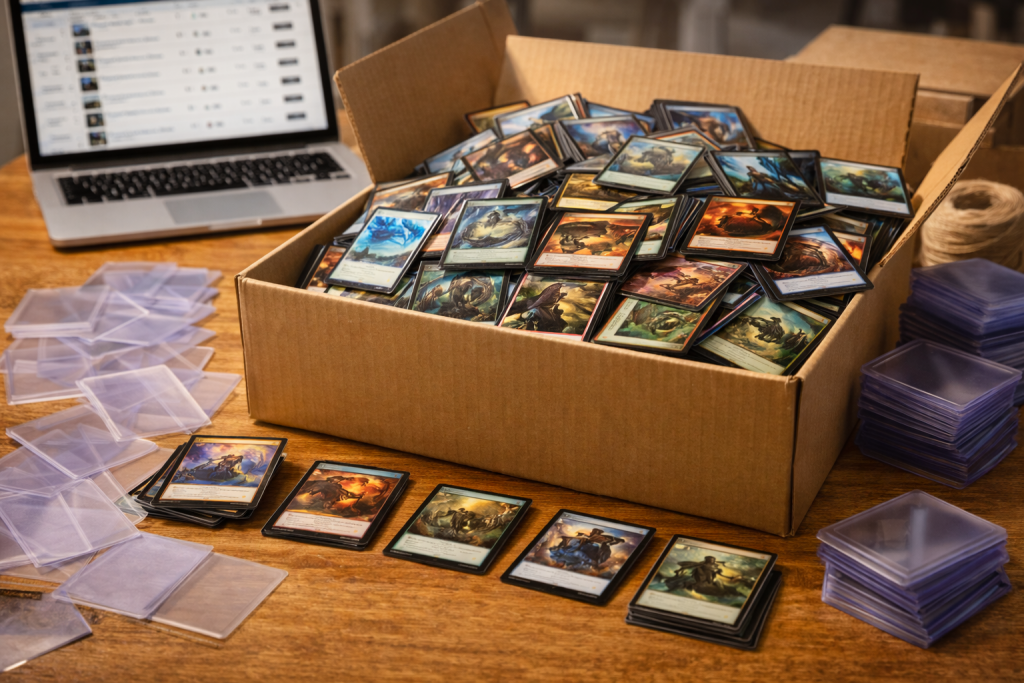
If you want to sell bulk magic cards without leaving money on the table, you need more than just a buylist and a prayer. Whether you’ve got a shoebox of draft chaff or ten thousand cards picked from a collection purchase, there’s a right way (and a very wrong way) to turn that cardboard into cash.
I’ve been selling MTG singles on eBay for years, and I’ve tried basically every method of moving bulk that exists. Some of them are great. Some of them are a waste of time disguised as convenience. This guide breaks down eight ways to sell bulk magic cards in 2026, ranked roughly by how much money you’ll actually keep at the end of the day.
But first, let’s make sure we’re talking about the same thing.
What Counts as “Bulk” (And Why It Matters)
The MTG community uses “bulk” loosely, so here’s how I think about the value tiers when deciding how to sell bulk MTG cards.
True bulk is the stuff worth fractions of a penny. Commons, uncommons, and basic lands that nobody is searching for. These are your $3 to $5 per thousand cards. You’re not listing these individually anywhere.
Bulk rares sit around $0.10 each. They’re technically rares, but the market doesn’t care. Think of that random mythic from a forgotten core set.
Above-bulk cards are where things get interesting. These are cards worth $0.25 to $3 that are too valuable for a bulk buylist but feel too cheap to justify spending five minutes creating an eBay listing for each one. This is the sweet spot where most sellers either leave money on the table or find a system that works.
Money cards and staples at $3 and above are worth individual listings on any platform. If you’re sitting on cards in this range and not listing them, you’re literally leaving dollars in the box.
The rest of this guide focuses primarily on the above-bulk and bulk rare tiers, because that’s where the biggest gap exists between what most people do (dump it all for buylist prices) and what they could be doing.
1. Sell Individual Singles on eBay for Maximum Return
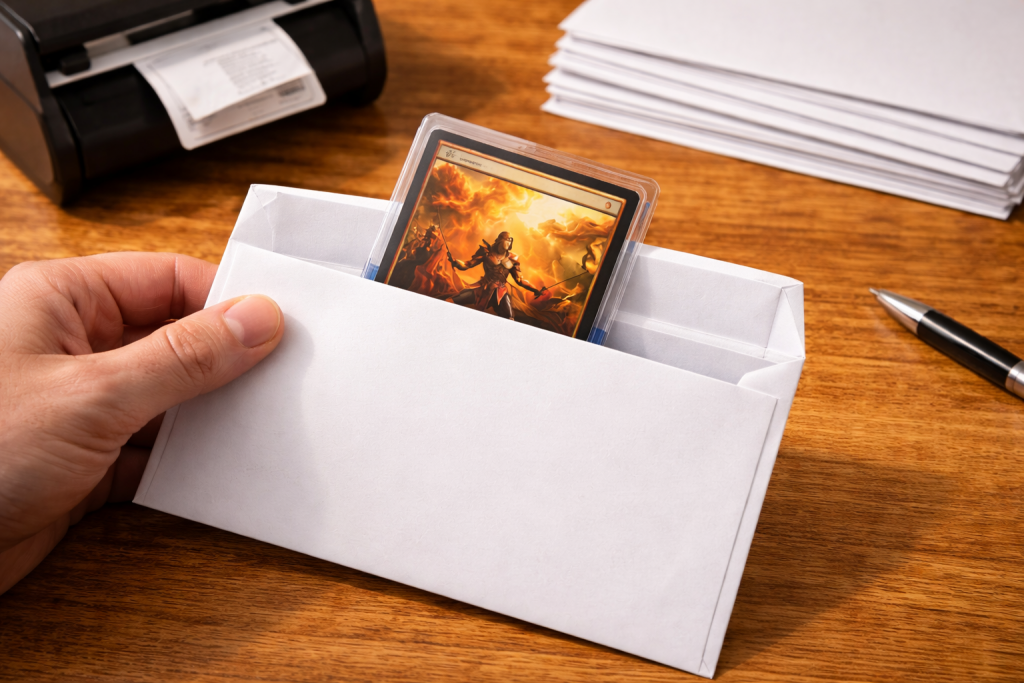
Here’s the thing most people overlook about eBay when it comes to selling bulk. eBay has a practical $0.99 minimum for Buy It Now listings, and shipping through eBay Standard Envelope (ESE) costs as little as $0.74 for a 1-ounce card. That means a buyer can grab a specific single they need for under $2 total.
Why does that matter? Because a huge portion of MTG buyers on eBay are looking for one specific card. They need that one copy of a commander staple or a sideboard piece, and they don’t want to order from TCGPlayer where they’d need to hit a store minimum or buy multiple cards to justify the shipping cost. eBay lets them grab exactly one card, pay under $2, and get it in their mailbox in a few days.
This is why eBay is the best platform for maximizing ROI on above-bulk singles. The $0.99 floor means you’re getting 5x to 10x more than any buylist would pay for the same card. Even after eBay’s 13.25% final value fee and the $0.30 per-order transaction fee, you’re still coming out way ahead on anything worth $0.50 or more at retail.
The math on a $2 card: You list it at $1.99 with free shipping. ESE costs you $0.74. eBay takes roughly $0.56 in fees. Your net is about $0.69. A buylist would have paid you $0.20 to $0.40 for that same card. It’s not life-changing per card, but multiply it by 500 cards and you’re looking at hundreds of dollars in difference.
Key takeaway: If you want to sell bulk magic cards for the most money possible, eBay singles with ESE shipping is the gold standard.
2. Use eBay’s CSV Bulk Upload to List Hundreds at Once
The obvious problem with Method #1 is that creating individual eBay listings is painfully slow if you’re doing it manually. Each card needs a title, item specifics, category, condition, price, photos, and shipping details. At 5 to 10 minutes per card, listing 200 cards is a full weekend project.
That’s where eBay’s File Exchange (bulk upload via CSV) comes in. Instead of creating one listing at a time through the eBay interface, you can upload a properly formatted CSV file and create hundreds of listings simultaneously.
The CSV needs specific columns for title, category ID, item specifics, price, quantity, shipping service, condition, and more. eBay is picky about the format, but once you have a working template, you can reuse it endlessly.
Step-by-step for CSV bulk listing:
- Build or obtain a CSV template that matches eBay’s bulk upload format for the Trading Cards category
- Fill in each row with the card’s details (name, set, condition, price, etc.)
- Map eBay category IDs and item specifics for each card
- Upload via eBay’s Seller Hub under the Listings tab
- Review the upload report for errors, fix any issues, and republish
The problem? Building that CSV manually still takes forever. You need to look up each card’s set number, map the correct eBay category, find or create images, and fill in a dozen item specifics fields. That’s where listing tools come in.
3. Use MTG Bulk Caster to Go From Collection App to eBay
If you already track your collection in Manabox, Moxfield, or Archidekt (and honestly, most of us do), MTG Bulk Caster lets you skip the entire manual CSV-building process. If you’re a Manabox user specifically, check out our guide on how to turn your Manabox collection into eBay listings in minutes.
Here’s how it works. You export a CSV from your collection app. MTG Bulk Caster imports it, matches each card against its database, and automatically pulls card images, maps eBay categories, and fills in item specifics. You set your pricing rules (markup multipliers, minimum prices, foil adjustments) and export an eBay-ready CSV. Upload it, and you’re done.
The whole workflow takes minutes instead of hours. It’s specifically built for the above-bulk cards that make up the majority of most collections. The $2 card that was never worth listing manually suddenly becomes profitable when you can list 200 of them in one sitting.
Pricing: There’s a free tier that covers 50 cards per month, and paid plans start at $7.99/month for 500 cards. That’s significantly cheaper than any scanner-based tool on the market. The tradeoff is that Bulk Caster works from collection app exports rather than physical card scanning, so you do need your cards cataloged in one of the supported apps first.
Who it’s best for: Anyone who already uses Manabox, Moxfield, or Archidekt and wants to sell bulk MTG cards on eBay without spending all weekend on data entry.
4. Use Scanner-Based Listing Tools for Physical Inventory
If your cards aren’t in a collection app and you’re working from physical inventory, scanner-based tools are the alternative approach.
TCG Automate is the most well-known option in this space. It uses AI image recognition to identify cards from a camera or scanner feed, then generates eBay listings with market pricing pulled from TCGPlayer. It supports multiple TCGs beyond just Magic (Pokemon, Yu-Gi-Oh!, sports cards, etc.) and can list to eBay, Shopify, and Whatnot.
TCG Automate’s pricing starts higher than collection-based tools. Plans are tiered by monthly card scans, and you’re looking at roughly $30 to $80+ per month depending on volume. The higher tiers ($155 to $185/month) are aimed at professional sellers doing tens of thousands of scans.
Card Dealer Pro is another scanner-based option, though it skews more toward sports cards and requires dedicated hardware. Pricing is in a similar range.
TCGPlayer Pro (Quicklist) offers scanning and listing tools through the TCGPlayer Seller Portal, but it’s designed for TCGPlayer marketplace sellers rather than eBay sellers. If you’re primarily selling on TCGPlayer, their scanning tools are solid and free at certain seller levels.
| Tool | Starting Price | Approach | Best For |
|---|---|---|---|
| MTG Bulk Caster | $7.99/month | Collection app CSV import | eBay sellers with digital collections |
| TCG Automate | ~$30+/month | Camera/scanner AI recognition | Multi-TCG sellers with physical inventory |
| Card Dealer Pro | ~$50+/month | Scanner + hardware | Sports card and high-volume sellers |
| TCGPlayer Quicklist | Free (with Pro) | Phone camera scanning | TCGPlayer marketplace sellers |
Key takeaway: Scanner tools are better if your cards exist only in physical form. Collection-to-CSV tools are better if you’ve already cataloged your cards digitally. Either way, any tool beats manual listing when you want to sell bulk magic cards at volume.

5. Ship to Card Conduit for Hands-Off Selling
Not everyone wants to deal with listing, pricing, shipping, and customer service. If you just want to box up your cards and get paid, Card Conduit is the most legitimate hands-off option for selling MTG cards.
Card Conduit is a service from the Cardhoarder team. You ship them your cards, they sort everything, grade conditions, find the best buylist prices across multiple vendors, and send you a check. It’s not consignment in the traditional sense. They’re finding optimized buylist prices, not listing your cards at retail.
Standard Service: 10% fee plus $0.03 per card. You can send unsorted cards, and they handle everything. The per-card fee means you should filter out nonfoil commons and basic lands before shipping, because those will cost you more in processing fees than they’ll earn.
Curated Service: 5% fee with no per-card charge. You pre-filter to only include cards with $0.50+ buylist value, and you send a maximum of about 150 cards per shipment. You can find full details on Card Conduit’s FAQ page.
Card Conduit claims their customers average 19% more than they’d get from a single major retail buylist, even after fees. The tradeoff is that you’re still getting buylist prices, not retail. For a card with a $2 TCG Low price, you might net $1.00 to $1.20 through Card Conduit. On eBay, that same card sold at $1.99 BIN would net you around $0.69 to $0.95 after fees and shipping.
Who it’s best for: Players and collectors who value their time over maximizing every dollar, and people with larger collections who want a reliable, transparent service.
6. Sell to Your Local Game Store
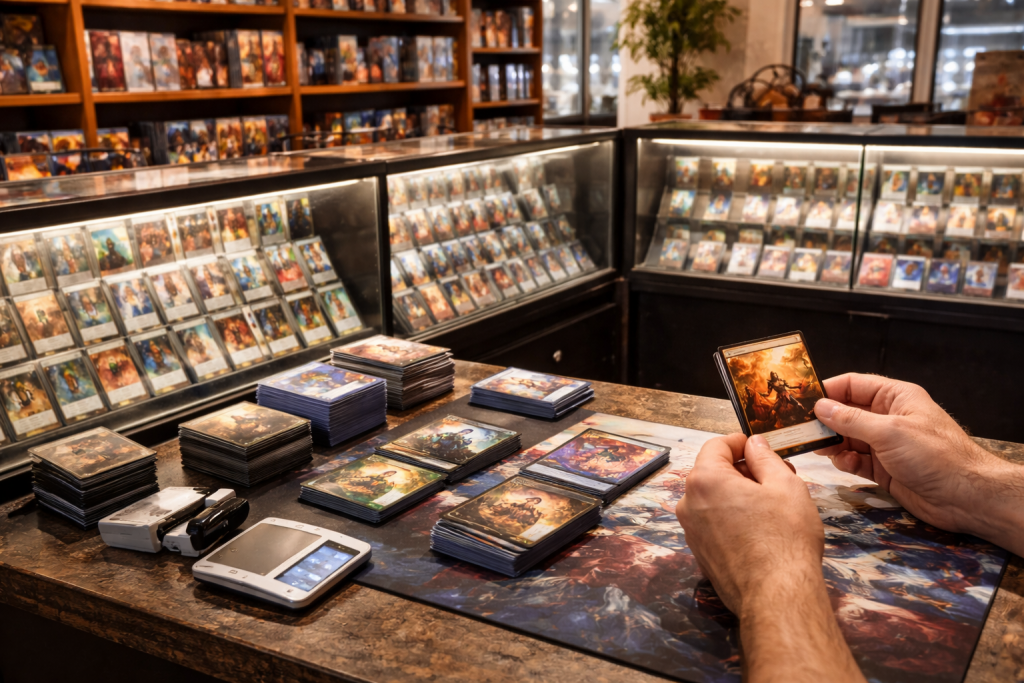
Your LGS will buy cards, but let’s be honest about what that means. Most local shops pay 40% to 60% of retail value on singles they actually want, and they’re paying bulk rates ($3 to $5 per thousand) on everything else. Some stores offer slightly better rates if you take store credit instead of cash.
The upside is that it’s instant. Walk in, hand them a box, walk out with money (or credit) the same day. No listing, no shipping, no customer service, no waiting for things to sell.
The downside is that you’ll consistently get the lowest return of any method on this list. Stores need margins to stay open, and bulk cards are not something most stores are excited to acquire unless they’re running low on specific sets.
Tips for getting better LGS prices:
Sort your cards by set and condition before bringing them in. Stores will sometimes pay more if you’ve done the sorting work for them. Call ahead and ask what they’re actively buying. Some stores have surplus on certain sets and will pass on bulk from those entirely. Ask about store credit rates versus cash. The credit rate is almost always better and can make sense if you’re buying sealed product or singles anyway.
7. Sell on Facebook Marketplace and MTG Groups
Facebook is an underrated option for moving bulk, especially in larger lots. There are dozens of active Facebook groups dedicated to buying and selling MTG cards, and Facebook Marketplace itself works well for local bulk sales.
The advantage of Facebook is zero seller fees. No 13% eBay cut, no platform commission. You list it, agree on a price, and either ship it or meet locally. For local sales, you also eliminate shipping costs entirely.
Where to sell on Facebook:
Facebook Marketplace is best for local bulk lot sales. List a “1,000 card MTG lot” or “complete set of [recent expansion]” with a few photos and a fair price. People shopping locally for Magic cards are often casual players or parents buying for their kids, and they’re not price-checking every card.
Dedicated MTG selling groups (search for “MTG Buy Sell Trade” or “Magic: The Gathering Sales”) are better for selling specific cards or curated lots. These groups are full of players who know card values, so your pricing needs to be competitive. The norm is usually TCG Low minus 10% to 15%.
The downsides: No buyer protection infrastructure like eBay offers. Scams are more common. Payments through PayPal Goods & Services add a small fee but provide some protection. Local meetups have their own logistical challenges. And the reach is limited compared to eBay’s global buyer pool.
8. Sell Bulk Lots on eBay or TCGPlayer
If you have true bulk (the commons, uncommons, and $0.10 rares that aren’t worth individual listings), selling in lots is the most practical move.
On eBay, you can list a “1,000 MTG Card Lot” or themed lots like “100 Red MTG Cards” or “50 Rare MTG Cards Lot” and price them well above the per-thousand bulk rate. Lot buyers on eBay are typically casual players, returning players, or people looking for quantity at a low price per card. A well-photographed lot with a clear description of what’s included (sets, rarities, conditions, whether there are any notable inclusions) will sell for significantly more than the $3 to $5 per thousand that a store buylist would pay.
On TCGPlayer, you can list bulk as “Bulk Lots” within their marketplace if you have a seller account. TCGPlayer’s audience is more price-savvy, so competition on lots tends to be tighter.
Tips for selling bulk lots:
Include a few recognizable cards or “hits” in each lot to make it more appealing. Be specific about what’s included. “1,000 MTG Cards” is vague and unappealing. “1,000 MTG Cards from Modern-Era Sets, 50+ Rares Included” tells the buyer exactly why they should care. Photograph the lot attractively. Spread the cards out, show the rares face-up, and use good lighting. Ship lots in a flat rate Priority Mail box for predictable costs.
Where to Source Bulk Magic Cards for Reselling
If you’re reading this as someone who wants to buy and resell bulk for profit (not just offload your own collection), sourcing is half the game. Buying bulk lots, collection purchases, and draft leftovers at the right price is what separates a hobby seller from someone running a legitimate side hustle.
We’re putting together a dedicated guide on how to source and buy bulk magic cards for reselling. Stay tuned for that one. It’s going to cover everything from estate sales and garage sales to online lot purchases and LGS relationships.
For now, the key principle is simple: your profit margin on bulk is determined at the point of purchase, not at the point of sale. If you buy a 5,000-card lot for $50 and pick 200 above-bulk cards worth listing individually on eBay, those 200 cards might generate $300 to $500 in sales. The remaining 4,800 cards can be relisted as bulk lots or donated. That’s the math that makes bulk reselling work.
How to Sell Bulk Magic Cards on eBay (Step-by-Step)
Since eBay is the highest-ROI option for most sellers, here’s the condensed workflow:
- Sort your cards into value tiers. Pull out anything worth $3+ for individual listing. Set aside above-bulk cards ($0.25 to $3) for bulk listing. Group true bulk for lot sales.
- Catalog your above-bulk cards in Manabox, Moxfield, or Archidekt. Scan them in or add them manually.
- Export the CSV from your collection app and import it into a listing tool like MTG Bulk Caster.
- Set your pricing rules. A common approach is TCG Low minus 10% to 15% as your baseline, with a minimum price of $0.99.
- Export the eBay CSV and upload it through Seller Hub.
- Ship using eBay Standard Envelope. At $0.74 per card for 1-ounce shipments, ESE keeps your margins healthy on low-value singles.
- Relist true bulk as lots for anything you didn’t list individually.
This workflow lets you sell bulk magic cards at every value tier without leaving money behind.