
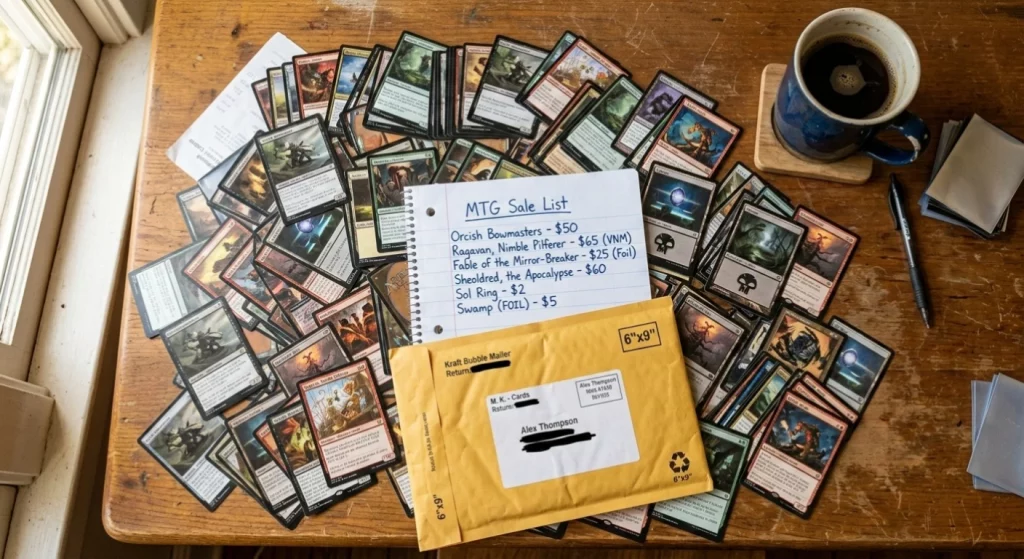
The biggest MTG selling mistakes aren’t always obvious until they’ve already cost you time, money, or both. This post covers seven of them, including a few I made for longer than I’d like to admit. If you’re trying to turn your collection into actual cash on eBay, fixing these will make a bigger difference than any pricing shortcut or shipping trick.
Why MTG Selling Mistakes Compound Fast
Selling Magic cards looks simple from the outside. Take a photo, write a title, set a price, ship it. But if you’re working through a collection of hundreds or thousands of cards, small inefficiencies stack up fast. A bad pricing habit repeated across 500 listings isn’t a small mistake. MTG selling mistakes at scale are expensive, and most of them are completely avoidable.
Key takeaway: The sellers who turn consistent profit on eBay aren’t necessarily smarter. They’ve just stopped repeating the same errors on every batch.
The 7 MTG Selling Mistakes That Hurt Your Bottom Line
Mistake 1: Treating Every Card the Same
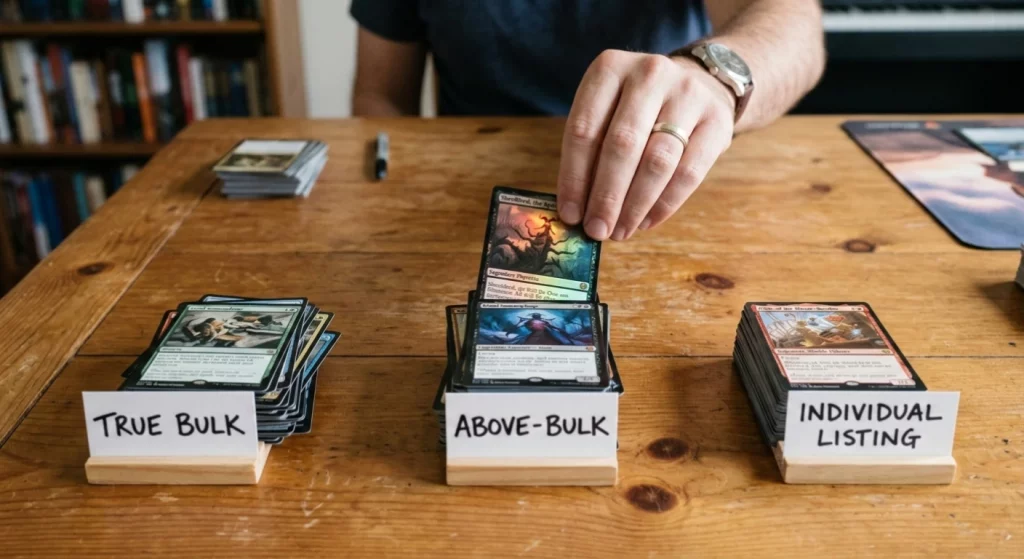
One of the most common MTG selling mistakes is applying the same strategy to every card regardless of its value. True bulk (under $0.25) doesn’t belong in individual eBay listings. Above-bulk cards ($0.25 to $3) don’t belong in the buylist box. Each tier needs a different approach, and mixing them up bleeds value in both directions.
A common mistake here is tossing $1 rares into a buylist at $0.05 each because listing them individually feels like too much work. That’s real money left on the table. The $2 card problem is the dead zone where a card is too valuable to dump at bulk prices but not valuable enough to justify manual listing. Those cards deserve a better answer.
Mistake 2: Ignoring the $2 Card Problem
This one deserves its own entry. Above-bulk cards sit in a dead zone for most sellers. Buylists lowball them. Manual listing is too slow for the return. So they sit in a box indefinitely, which means they’re worth exactly zero.
The fix is batch listing. When you can process 500 of these in a single session using a CSV export from ManaBox or Archidekt, the math changes completely. MTG Bulk Caster was built specifically for this problem. You don’t need to scan anything or manually enter card names one at a time. Export your collection, upload the file, apply your pricing rules, and get an eBay-ready CSV back in minutes.
Mistake 3: Pricing Off the Top of Your Head
Gut-feel pricing is one of the MTG selling mistakes that’s hardest to catch because sometimes it accidentally works out. But if you’re not anchoring consistently to TCG Low, TCG Mid, or TCG Market Price, you’re either leaving money on the table or pricing yourself out of sales without realizing it.
The standard approach for above-bulk cards on eBay is to price near TCG Low, maybe slightly below, since eBay buyers expect a discount versus TCGPlayer for singles. Pricing at TCG Mid without thinking about it means fewer sales. Pricing below TCG Low as a default means you’re subsidizing buyers for no reason.
Here’s how to do it right:
Step 1: Pull the TCG Market Price for any card you’re uncertain about.
Step 2: Price at or just below TCG Low for fast-moving above-bulk cards.
Step 3: For higher-value singles ($3 and up), check recent eBay sold listings to see what buyers actually paid, not just what sellers are asking.
Mistake 4: Skipping eBay Standard Envelope
Shipping is where a lot of eBay profit quietly disappears. If you’re putting penny-sleeved singles in bubble mailers with full tracked shipping on every order, your margins on $1 and $2 cards are getting crushed.
eBay Standard Envelope exists for exactly this use case. It’s a discounted label for trading cards under the weight and price threshold, and it’s dramatically cheaper than standard tracked shipping. Non-machinable stamp rules apply if you go outside the specs, but for a couple of cards in a PWE with a top loader or team bag, ESE is the right call every time. Not using it is one of the MTG selling mistakes that silently kills your margin on low-value singles.
For a breakdown of what actually survives the mail, the best top loaders for shipping trading cards covers what holds up and what doesn’t.
Mistake 5: Poor Listing Quality on Cards That Deserve Better
For true above-bulk cards, listing quality is less critical. Buyers expect a basic listing when they’re paying $0.75. But for anything $5 and up, bad photos and vague condition notes will cost you sales. Buyers at that price point want to see the card before they commit.
A common mistake is writing “NM” in the title with no actual scan to back it up. A clear photo showing the card face, honest wear notes, and a real condition description go a long way. This isn’t just about protecting yourself from returns. It’s about building feedback that makes every future listing convert better.
Mistake 6: Using the Buylist for Above-Bulk Cards
Buylists are excellent for money cards, true bulk by the thousand, and cards with fast price decay. They’re a bad deal for above-bulk cards where the spread between buylist price and market price is massive.
A $1.50 card might get you $0.15 from a buylist. That same card listed on eBay in a batch with 499 others might sell for $1.10 after fees. Multiply that spread across 200 cards and you’ve left a meaningful amount of money on the table just to save yourself some friction.
MTG selling mistakes around buylists usually come down to convenience. Buylists are fast and you get paid the same day. But if your goal is to actually maximize what your collection earns, the above-bulk tier needs a different home.
Mistake 7: Never Building a Repeatable System
This is the biggest one. Most sellers who give up on selling Magic cards don’t quit because eBay is bad or the margins aren’t there. They quit because the process is exhausting and inconsistent. Manually listing cards one at a time, calculating shipping on every order, pricing from memory, packing with no standard workflow. It all compounds into a grind.
The MTG selling mistakes that do the most long-term damage are the ones baked into your process. A bad pricing habit run through 2,000 cards is a real problem. A good system run through 2,000 cards is an actual side income.
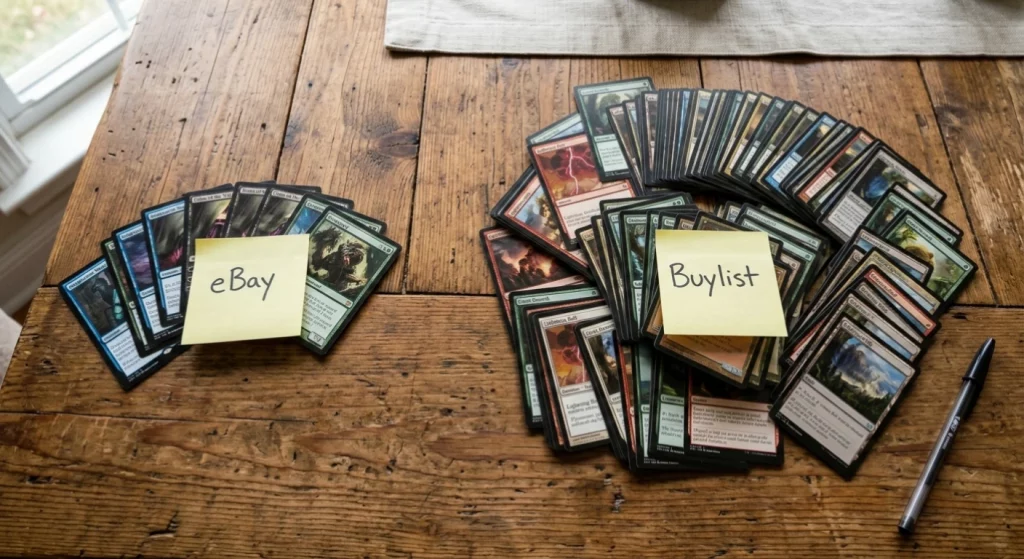
Here’s how a clean workflow looks at the high level: collect your cards, sort by value tier, send true bulk to buylists, export above-bulk to a batch listing tool, list in batch, ship with ESE, repeat. Each step has a clear decision and a standard output. That’s what separates people who actually move cards from people who have a pile and good intentions.
Get started with MTG Bulk Caster and see how quickly a batch workflow changes the math on your above-bulk backlog.
What Fixing These Mistakes Actually Looks Like
Once you stop repeating these MTG selling mistakes, the workflow changes fast. Above-bulk cards stop piling up. Your pricing is consistent and defensible. Shipping costs are under control. And you’re not spending a Sunday afternoon manually entering card names into eBay one by one.
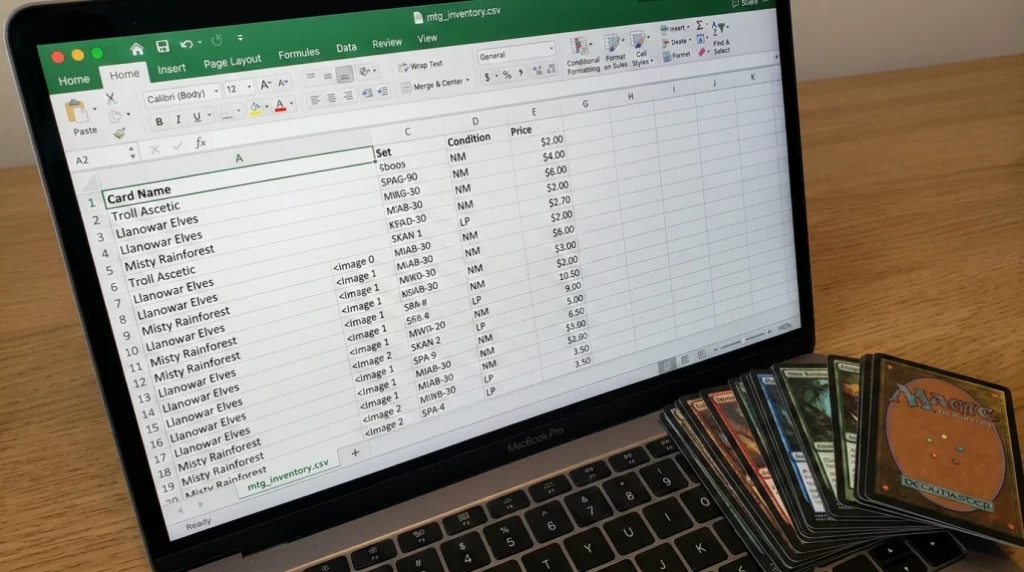
For sellers working out of Manabox, the process is straightforward. Export your collection as a CSV, upload it to MTG Bulk Caster, set your pricing rules, download the eBay-ready file, and upload to eBay. If you’re not already using Manabox, turning a Manabox collection into eBay listings walks through the full workflow step by step.
The free tier handles 50 cards per month. Paid plans start at $7.99 for 500 cards. For a single sorting session after a draft or set release, that’s usually enough to see whether the workflow fits how you already sell.