
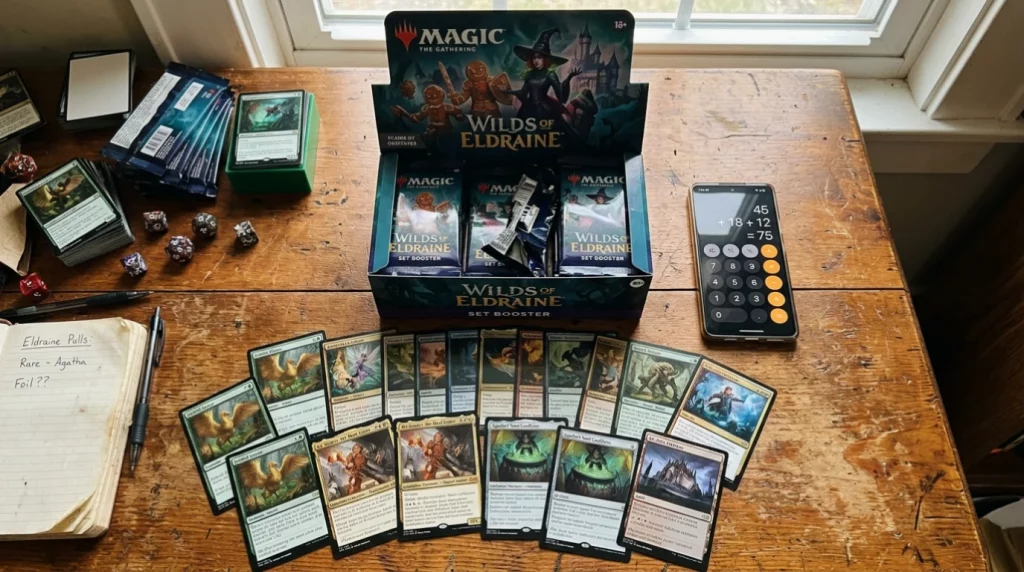
MTG expected value is the single most important number to understand before you rip open any sealed Magic: The Gathering product for resale. EV tells you the average dollar amount of singles you can expect to pull from a box. And when you compare that number against what you paid for the box, you get a clear picture of whether you’re making money or lighting it on fire.
I’ve cracked hundreds of boxes over the years, and I’ll be honest: most of the time, opening sealed product at full retail is a losing proposition. The math doesn’t work unless you know how to find the right product at the right price, extract maximum value from every card you pull, and use tools that keep your labor costs from eating your margins alive. That’s what this guide is about.
We’re going to cover how MTG expected value calculations actually work, the best tools for checking EV on any set, how to set up a price alert system so you only buy boxes when the numbers make sense, where to sell the cards you pull for maximum return, and how large-scale operations use sorting machines to turn box-cracking into a real business. Let’s get into it.
What MTG Expected Value Actually Means (and Why Most People Get It Wrong)
Expected value is a statistical concept. For a Magic booster box, it works like this: you take every card that could appear in a pack, multiply each card’s market price by the probability of pulling it, and add those numbers together. Do that for every slot in the pack, multiply by the number of packs in a box, and you get the box EV.
Here’s where people screw up. They see a box with a $180 MTG expected value listed on a tracking site and think that means they’ll get $180 worth of cards from every box. That’s not how averages work. EV is a long-run number. Open one box and you might pull $300 in value or $60. Open a hundred boxes and your average will converge toward that $180 figure. Variance is brutal in small samples.
The other mistake is ignoring what happens after you pull the cards. An MTG expected value of $180 doesn’t mean $180 in your pocket. You still have to account for platform fees (eBay takes roughly 13%, TCGplayer takes 10-13%), shipping costs per card, the time it takes to list and ship everything, and price decay on cards that sit in your inventory for weeks.
Smart resellers don’t look at raw MTG expected value. They look at what I’d call “net realized value,” which is the EV minus fees, minus shipping, minus an honest accounting of the labor involved. When that number is higher than what you paid for the box, you have a profitable product. When it’s not, you’re subsidizing your hobby and calling it a business.
Play Boosters vs. Collector Boosters: Different Math
Not all boxes are created equal. A Play Booster box (36 packs) and a Collector Booster box (12 packs) have completely different MTG expected value profiles for the same set.
Play Booster boxes generally have lower raw EV but also cost less. The variance is lower because you’re opening more packs, which smooths out your results. Most of the value comes from the rare/mythic slot, with a smaller contribution from foils and special guest/list cards.
Collector Booster boxes have higher raw MTG expected value but cost two to three times as much. The variance is extreme. A single extended art mythic or serialized card can make or break the entire box. If you’re opening Collector Boosters for profit, you need enough volume to ride out the variance, or you need to get the box at a significant discount to retail.
For most small-to-medium resellers, Play Booster boxes bought below EV are the safer play. Collector Boosters are a volume game best suited for sellers who can absorb the swings.
The 5 Best Tools for Calculating MTG Expected Value
You don’t need to build spreadsheets from scratch. Several MTG expected value tools exist that do the math for you, and they range from free community resources to premium platforms built for professional sellers.
1. Dawnglare (mtg.dawnglare.com) – Free
Dawnglare has been the community standard for MTG expected value calculations for years. It lists the EV of booster boxes for virtually every Magic set ever printed, updated regularly with current TCGplayer pricing.
The upside is that it’s free, fast, and covers a huge number of sets. The downside is that Dawnglare’s MTG expected value calculations assume cards worth less than $1 are worthless (which isn’t entirely true if you have the tools to sell them), and it doesn’t always account for foil variants or special treatments in newer sets. For a quick gut check on whether a set is worth opening, it’s hard to beat. Just don’t treat the number as gospel.
2. The Expected Value (theexpectedvalue.com) – Free/Patreon
This is one of the more transparent MTG expected value calculators in the space. It covers Play Boosters, Collector Boosters, Commander precons, Secret Lairs, and bundle products. What sets it apart is that the assumptions behind every calculation are visible and auditable. You can see exactly how each booster slot contributes to the total EV.
The site also has a YouTube channel where they walk through EV breakdowns for new sets as they release, which is useful if you want to understand the methodology rather than just seeing a number. Free tier gives you access to the calculators. Patreon supporters get additional tools and early access.
3. MTGStocks (mtgstocks.com/analytics/expectedvalue) – Free
MTGStocks is primarily known as a price tracking and portfolio tool, but their expected value analytics section breaks down MTG expected value for current and older sets. It uses live pricing data and provides a clean, sortable interface. Useful for comparing multiple sets side by side to find which products have the best current EV relative to their purchase price.
4. EchoEV (echoev.app) – Free/Early Access
EchoEV is a newer entrant that tracks daily MTG expected value changes for sealed products using a slot-based pricing model. It calculates EV by looking at each booster slot individually, multiplying the probability of each card pool by its average price, and summing the results. The daily tracking is the standout feature because it lets you see how a set’s EV trends over time. Sets typically lose EV in the weeks following release as supply increases and chase card prices drop. Being able to see that curve helps you time your purchases.
5. Mox Alpha (moxalpha.com) – Paid
Mox Alpha is the professional-grade option. It’s a paid tool designed for high-volume resellers who crack sealed product as a core part of their business. It provides two key datapoints: Average EV (the statistical MTG expected value of the contents) and Average Direct Total (the EV minus seller fees, giving you a closer approximation of actual profit).
Mox Alpha simulates 10,000 box openings using third-party pull rate data and live TCGplayer pricing. It also provides arbitrage reports, trending product data, and returns modeling for current and future inventory. If you’re opening dozens of boxes per set, this is the tool that tells you exactly which products to buy and at what price. It’s not cheap, but for volume sellers, the data pays for itself.
Which Tool Should You Use?
If you’re a casual seller opening a few boxes here and there, Dawnglare and The Expected Value are more than enough to check MTG expected value before buying. If you’re trying to build a repeatable system for buying underpriced product, layer in EchoEV’s daily tracking. And if you’re running a serious operation, Mox Alpha is the professional standard.
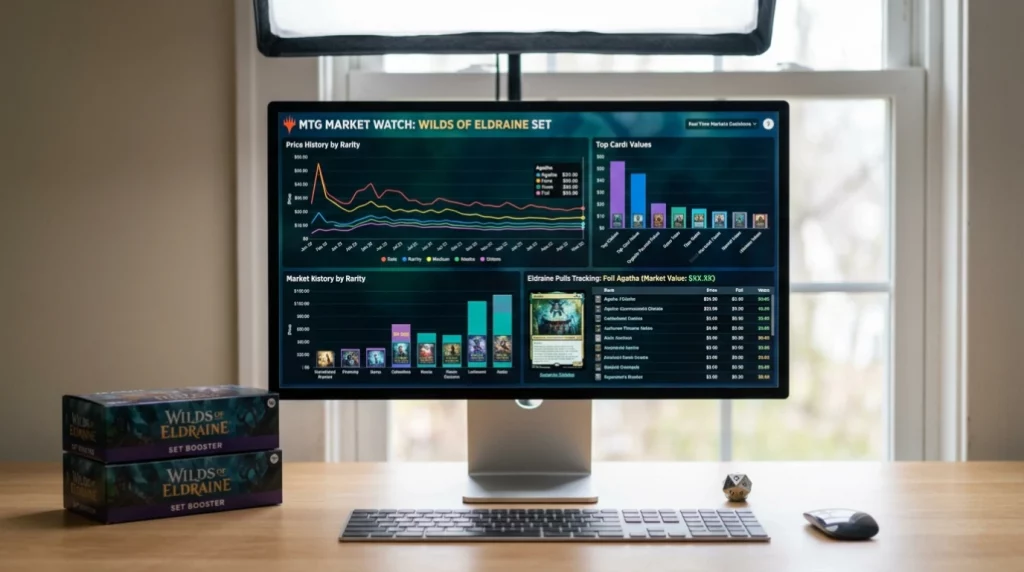
How the MTG Expected Value Calculation Actually Works (So You Can Sanity-Check the Tools)
Understanding the MTG expected value formula helps you spot when a tool’s numbers look off. Here’s the basic framework.
A standard Play Booster pack has multiple slots, each with different card pools and probabilities. For the rare/mythic slot, roughly 1 in 7.4 packs contains a mythic rare. The rest contain a regular rare. You take every mythic in the set, average their market prices, multiply by the mythic probability. Do the same for rares. That gives you the expected contribution of the rare slot per pack.
Repeat this for the uncommon slots, the common slots (almost always near zero), the foil slot, any wildcard/list slots, and special treatments like borderless or extended art variants. Sum all the slot contributions and you have the EV per pack. Multiply by 36 for a Play Booster box.
Most MTG expected value calculators set a price floor at $0.25 or $1.00, meaning any card below that threshold is treated as zero. This is reasonable if you’re selling cards one by one on TCGplayer, where the per-card fees and shipping make sub-dollar cards unprofitable. But if you’re bulk listing on eBay and your listing cost per card is near zero, those $0.50 and $0.75 cards actually add up. Keep that in mind when comparing your real results against what the tools predict.
How to Find Sealed Product Below EV (The Actual Money Move)
Knowing the MTG expected value is only half the equation. The real skill is buying product at a price that makes the math work. Here’s how to set up a system for that.
Step 1: Know Your Target Buy Price
Take the MTG expected value from whichever tool you trust. Subtract 25-30% for platform fees and shipping costs. That gives you your break-even buy price. Anything you pay below that number is profit margin.
For example, if a Play Booster box has a $160 EV and you estimate 25% in fees and shipping, your break-even is $120. If you can buy the box at $100, you’ve got roughly $20 in expected profit per box before labor. At that point, the question becomes whether your listing process is efficient enough to make $20 per box worth the time.
Step 2: Set Up Price Alerts on Amazon with CamelCamelCamel
Amazon is one of the best sources for below-market sealed product, especially when boxes go on sale during Prime Day, holiday promotions, or when a set is approaching rotation. The problem is that good deals sell out fast.
CamelCamelCamel solves this. It’s a free Amazon price tracker that lets you set a target price for any product. When the price drops to your threshold, you get an email notification.
Here’s how to set it up for MTG boxes. Find the booster box you want to track on Amazon and copy the product URL. Go to camelcamelcamel.com and paste the URL into the search bar. You’ll see a price history chart showing the product’s highs and lows over time. Click the price alert icon next to “Amazon” (the price type that tracks Amazon’s own listings, not third-party sellers). Set your desired price. Use your break-even calculation from Step 1 as your target. Click “Start Tracking” and enter your email.
You can also install the Camelizer browser extension, which adds price history and alert buttons directly to Amazon product pages. This makes it trivially easy to set alerts on every booster box you’re interested in.

Step 3: Set Up Price Alerts on TCGplayer
TCGplayer is another common source for sealed product. The TCGPriceAlert Chrome extension and TCGPriceAlert.com let you set target prices for both singles and sealed products on TCGplayer. The free tier supports up to 15 active alerts with email and Telegram notifications. Paid tiers increase alert limits and update frequency.
tcgSniper is another option that focuses specifically on price drop alerts for TCGplayer listings, supporting Magic, Pokemon, and Yu-Gi-Oh products.
Step 4: Watch Distributor and LGS Sales
Amazon and TCGplayer aren’t the only game. Local game stores (LGS) sometimes run clearance sales on older product. Distributors occasionally dump overstock at steep discounts. Facebook groups dedicated to MTG buying/selling often surface deals from sellers looking to liquidate.
The key is having your target numbers ready so you can act fast when a deal appears. If you know that your break-even on a Foundations Play Booster box is $105, and someone posts one for $85 in a Facebook group, you don’t need to think. You just buy.
Step 5: Track Restock Alerts with TrackaLacker
TrackaLacker is a restock and price tracking tool with a mobile app that monitors product availability across retailers. You can follow specific Magic products and get notified when they come back in stock or hit a sale price. Useful for limited-run products like Masters sets or special releases that sell out quickly at retail and then spike in price.
Where to Sell the Cards You Pull (and How to Maximize Each Channel)
Opening boxes is only profitable if you can actually move the cards. Different price tiers demand different selling strategies, and the platform you choose matters more than most people realize.
eBay: Best for $2-$20 Singles and Bulk Listings
eBay is my primary selling platform, and it’s where the math works best for the “above-bulk” cards that make up most of what you’ll pull from any box. These are the $2 to $10 rares, the foil uncommons, the commander staples that aren’t chase cards but aren’t worthless either.
The challenge with eBay has always been the listing process. Creating individual listings for 200+ cards from a box opening used to take an entire weekend. That’s where tools like MTG Bulk Caster change the equation. You scan your pulls into a collection app like Manabox, export the CSV, import it into Bulk Caster, set your pricing rules, and export an eBay-ready file. What used to take hours takes minutes.
This matters for MTG expected value calculations because most EV tools set their price floor at $1. Every card below $1 is treated as zero. But if your listing cost per card is effectively nothing (because you’re bulk listing via CSV), those $0.50 and $0.75 cards add real value. Over a case of six boxes, those “worthless” cards might add up to $50 or more in additional revenue. That’s margin that manual listers leave on the table.
If you want a deeper walkthrough on the eBay listing process, I wrote a full guide on how to sell MTG cards on eBay that covers everything from account setup to shipping.
TCGplayer: Best for $10+ Singles
For your high-value pulls ($10 and above), TCGplayer often nets you a better price because the buyer base is more concentrated. Magic players shopping for specific singles tend to check TCGplayer first.
The fee structure is comparable to eBay at around 10-13% total. The main drawback for new sellers is TCGplayer’s level system, which caps your initial listings at 100 items. If you’re opening multiple boxes and pulling 30+ cards worth listing on TCGplayer, you’ll hit that cap fast. I did a full comparison of TCGplayer vs. eBay for selling MTG if you want the detailed breakdown of fees, seller levels, and which platform wins in different scenarios.
Facebook Groups: Best for Collection Lots and Quick Sales
Facebook marketplace and MTG-specific buy/sell groups are underrated for moving product. You can sell directly to other players with no platform fees, which means you keep more of each sale. The trade-off is that there’s no built-in buyer protection, so transactions require more trust, and pricing tends to be lower since buyers in these groups expect a discount below TCG Low.
Facebook is especially useful for moving playsets, bulk lots, and entire box breaks as a single transaction. If you opened a case and want to sell all the commons and uncommons as a lot rather than sorting and listing them individually, Facebook is the place.
Buylists: Best for Moving Inventory Fast
Card Kingdom, Star City Games, and other major retailers maintain buylists where they’ll buy specific cards at set prices. You won’t get retail value (expect 50-70% of market price), but the speed and convenience are hard to beat. Ship a package, get paid. No individual listings, no packing slips, no customer service.
Buylists are best for cards you need to move quickly, especially if a card is trending down in price and you want to lock in value before it drops further. They’re also the most practical outlet for true bulk (commons and uncommons at $3-5 per thousand).
The Smart Multi-Channel Approach
Here’s how I think about it after opening a box:
Cards $20 and above go on TCGplayer for maximum price. Cards $2-$20 get bulk listed on eBay using MTG Bulk Caster because the listing speed makes them profitable. Cards $0.50-$2 either get added to the eBay bulk upload (if I’m already running a batch) or go into the buylist pile. True bulk (sub-$0.25) gets sold as lots on Facebook or buylisted at $3-5 per thousand.
This tiered approach is how you actually capture close to the theoretical MTG expected value rather than leaving half of it on the table by only listing the obvious money cards.
Card Sorting Machines: How the Big Operations Maximize Every Box

If you’ve ever wondered how large-scale card resellers open hundreds or thousands of boxes and still capture the full MTG expected value from every product, the answer is card sorting machines. These are commercial-grade devices that scan, identify, and physically sort trading cards at speeds no human can match.
The Machines on the Market
Roca Sorter (by TCGplayer) is one of the most recognized names. It uses image recognition to identify and sort cards from Magic, Pokemon, Yu-Gi-Oh, Lorcana, and One Piece. The standard Roca Sorter handles up to 1,000 cards per run, while the Roca Sorter Max handles up to 3,000. It can sift for valuable cards, alphabetize inventory, create custom repacks, and even organize cards by pull sheet for order fulfillment. Pricing starts around $20,000 for the base model and $32,000+ for the Max.
PhyzBatch-9000 (by TCG Machines) is a Canadian-built machine that sorts at 60 cards per minute (3,600 per hour) using a double-roller conveyor system. It includes patented foil detection technology and sorts by price, set, color, rarity, and more. TCG Machines offers both lease and purchase options. The company has deployed hundreds of machines and processed over a billion cards across their install base.
CardBot (by CardCastle) is another option designed for TCG singles businesses. It has a smaller footprint and runs quietly, making it more suitable for in-store use. It handles sifting and sorting with image recognition and integrates with various e-commerce platforms.
Super Sorter (by MTech Cave) uses SortSwift software and supports custom sorting algorithms. It covers Magic, Pokemon, Yu-Gi-Oh, Flesh and Blood, Lorcana, One Piece, and Digimon.
Who Actually Uses These?
Card sorting machines aren’t for the person opening one box per set. They’re for game stores, high-volume resellers, and companies that have turned sealed product opening into an industrial process.
One of the more transparent examples is RNG Gamez, a trading card business that documents their operations on YouTube and sells across eBay, Amazon, and their own Shopify store. Companies like this buy sealed product in bulk (often at distributor pricing), open everything, sort it through machines, and sell the singles across multiple platforms. The machines handle the most labor-intensive part: sorting thousands of cards by set, value, and condition so that staff can focus on listing and shipping.
The Gaming Company, cited in TCG Machines testimonials, opens over 20,000 booster boxes per year with a staff of 50+. They’ve called the PhyzBatch-9000 the most important tool in their operation. At that scale, a $20,000+ machine pays for itself within months through labor savings alone.
Does This Scale Down for Smaller Sellers?
Honestly, not yet. At $20,000 to $32,000 for a commercial sorter, you’d need to be processing tens of thousands of cards per month to justify the investment. For the average side-hustle seller opening a case or two per set, the labor savings don’t outweigh the cost.
What does scale down is the software side of the equation. Collection apps like Manabox handle the scanning and identification. Tools like MTG Bulk Caster handle the listing automation. You’re essentially doing what the big operations do with machines, just at a smaller scale and with your phone camera instead of a $25,000 robot. The workflow is scan with Manabox, export CSV, import into Bulk Caster, set pricing rules, export to eBay. It’s not as fast as a PhyzBatch, but it turns a weekend of manual listing into a 15-minute process.
Timing Your Purchases: When MTG Expected Value Is Highest and Product Is Cheapest
EV and product price move in opposite directions over a set’s lifecycle, and understanding that curve is how you find the sweet spot.
The Release Window (Weeks 1-3)
Chase card prices are at their peak because supply is low and demand from brewers and competitive players is high. But box prices are also at their highest (full MSRP or above). The EV looks amazing on paper, but you’re paying full price for the product and the singles will start dropping within days. This is the worst time to buy boxes for cracking. The best play during release week is to sell the singles you pull from prerelease or launch events, not to buy more boxes.
The Settling Period (Weeks 4-12)
Card prices decline as more product enters the market. The MTG expected value of a box drops. But box prices also start dropping as retailers compete for sales. This is when you start watching for deals. If you can find boxes at 20-30% below MSRP while the EV is still positive after fees, you’re in the profit zone.
The Long Tail (3+ Months Post-Release)
Standard-legal sets continue to lose MTG expected value as supply saturates the market. But certain sets stabilize or even gain EV over time if they contain cards that see increasing play in Commander, Modern, or Pioneer. Reprint sets (Masters, Horizons) tend to hold EV better than Standard sets because the reprints were already in demand. This is also when Amazon deals show up most frequently. Retailers clear old inventory to make room for the next set, and you’ll see boxes drop well below the original MSRP.
The CamelCamelCamel Strategy in Practice
Set up price alerts for boxes during the release window at your calculated break-even price. You probably won’t get a hit right away. But three months later, when the retailer drops the price to move inventory, your alert fires and you buy at a price where the math works. It’s not exciting, but it’s profitable.
A Real Example: Running the Numbers on a Box
Let’s walk through this with a hypothetical to make it concrete.
Say you’re looking at a Play Booster box with a current MTG expected value of $155 (according to Dawnglare) and a retail price of $130 on Amazon.
At first glance, that looks great. $155 in cards for $130? Sign me up. But let’s apply the real math.
Take the $155 EV and subtract 13% for eBay fees: that leaves $134.85. Subtract an estimated $15 in shipping costs across all the cards you list (assuming PWE at $1.10 each for roughly 15 cards worth listing individually). You’re at $119.85. Now subtract the cost of supplies (sleeves, top loaders, envelopes) at roughly $5 per box worth of shipments. You’re at $114.85.
That’s your net realized value. You paid $130 for the box. You’re losing $15.15 on average.
Now run the same numbers, but assume you found the box on sale for $95 through a CamelCamelCamel alert. Same $155 EV, same deductions. Net realized value of $114.85 minus $95 purchase price = $19.85 profit per box. Open a case of six boxes and you’re looking at roughly $120 in profit.
That’s the difference between losing money and making money. Same set, same EV, same selling process. The only variable was the purchase price. This is why the price alert system matters so much.
And here’s where it gets interesting. That $120 profit assumes you’re treating all the bulk commons, uncommons, and sub-dollar rares as worthless. Every MTG expected value calculator does this. But you don’t have to. Get a little creative with how you package the leftovers and you can squeeze another $30 to $60 out of a case that the spreadsheet says is worth zero.
Think about it from the buyer’s perspective. A random pile of 500 commons is worth almost nothing. But a curated lot of “100 Red Commander Staples” or “Complete Uncommon Playset from Duskmourn” tells a story that someone will pay $10 to $15 for. Mystery repacks are another angle. Throw 5 rares and 20 uncommons into a team bag, list it as a mystery pack for $5.99, and suddenly cards that would have sat in a box forever are moving. Themed starter bundles for new players (one of each color with lands included) sell surprisingly well on eBay and Facebook groups.
Some sellers take this even further by sorting bulk by color and selling “lot of 200 Blue cards for Commander deck building” listings that move consistently. Others create set-complete common/uncommon sets for collectors who want the full binder experience without cracking 36 packs themselves. None of these are individually huge money. But when you’re already opening the packs and already sorting the cards, the incremental effort is minimal and the incremental revenue is real. Over a case, that’s the difference between $120 in profit and $160 or $180. Over a year of buying discounted product, that creativity with bulk compounds into serious money that the MTG expected value calculators never predicted.