
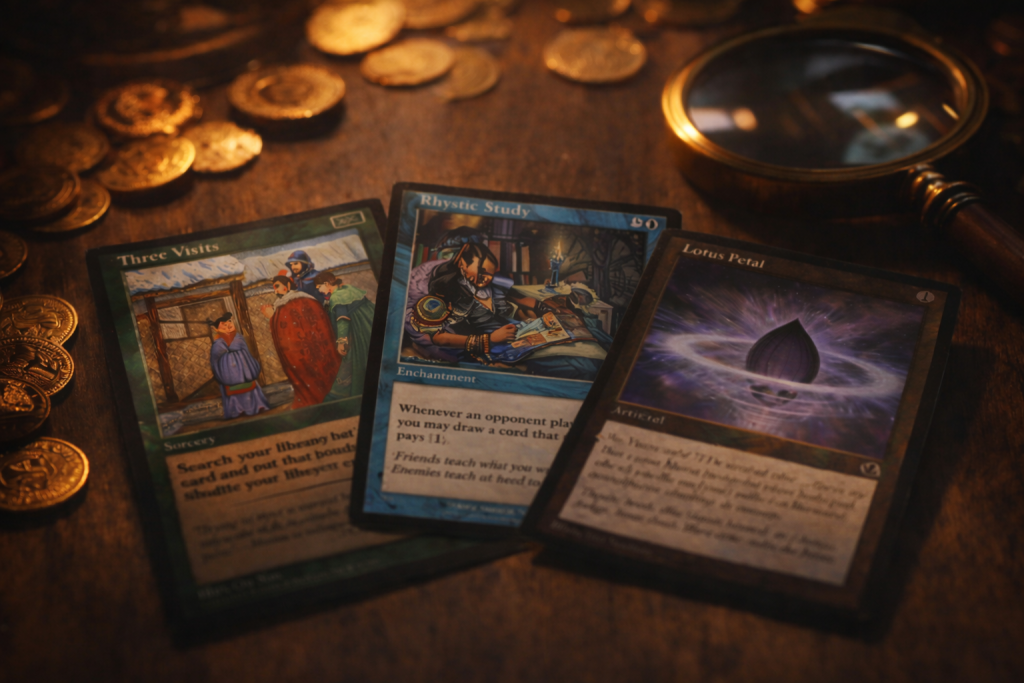
The most expensive common MTG cards will absolutely shock you if you’ve never looked into this corner of the market. We’re talking about cards printed at common rarity that sell for $15, $30, even $80 or more for a single copy. That’s not a typo. Commons. The cards most players toss into a shoebox and forget about.
I’ve been selling Magic: The Gathering singles on eBay for years, and one of the first lessons I learned is that rarity doesn’t always equal value. Some of the priciest cards in the game were originally printed at common, and if you’ve been playing long enough (or inherited someone’s old collection), you might be sitting on cards worth real money without even knowing it.
So let’s break down the 10 most expensive common MTG cards of all time. For each one, I’ll cover what set they appeared as a common in, why they got so expensive, what formats drive their demand, and what kind of prices you can actually expect on the secondary market in 2026.
Why Are Some Common Cards So Expensive?
Before we get into the list, it helps to understand the three main reasons a common card ends up being worth serious money.
Set scarcity. Certain sets were printed in tiny quantities, especially Portal Three Kingdoms and early expansions like Legends and Antiquities. When supply is extremely low, even bad cards carry a premium.
Format demand. A card printed at common in 1998 might be a four-of staple in Legacy, a cornerstone of Pauper, or an auto-include in every Commander deck of its color. Demand from competitive and casual formats pushes prices up, especially when the card has limited printings.
No reprints. Wizards of the Coast has reprinted many powerful commons over the years, but some have slipped through the cracks entirely. A card that has never been reprinted and only exists in one old set is going to command a premium almost by default.
With that context, let’s get into the list.
1. Three Visits (Portal Three Kingdoms, 1999)
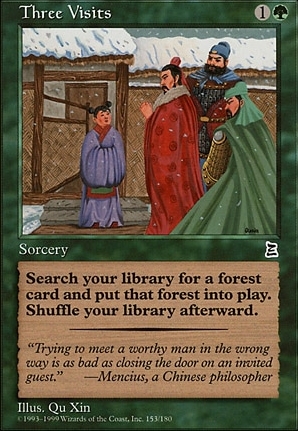
Current price (PTK printing): ~$75 to $85
Three Visits is a green sorcery that costs 1G and lets you search your library for a Forest card and put it directly onto the battlefield. If that sounds familiar, it should. It’s functionally identical to Nature’s Lore, one of the best two-mana ramp spells in Magic.
Three Visits was originally printed as a common in Portal Three Kingdoms, a set released in 1999 that was designed specifically for Asian markets and saw an extremely limited English print run (mostly sold in Australia and New Zealand). That scarcity is the foundation of its price. For over two decades, Three Visits was essentially unobtainable for most Western players. The PTK printing regularly sold for over $100 during its peak years.
Wizards finally reprinted Three Visits in Commander Legends in 2020 (at uncommon rarity), and it has appeared in several Commander preconstructed decks since then. Those reprints brought a much more affordable version to market at around $5 to $8. But the original Portal Three Kingdoms printing? Still a collector’s item sitting in the $75 to $85 range.
Three Visits is not on the Reserved List, so additional reprints are always possible. But for collectors, the PTK common version carries a mystique that newer printings simply can’t replicate. It’s legal in Commander, Legacy, Pauper, and Vintage. In Commander specifically, it’s one of the most-played green ramp spells in the format, appearing in thousands of decklists every year.
2. Rhystic Study (Prophecy, 2000)
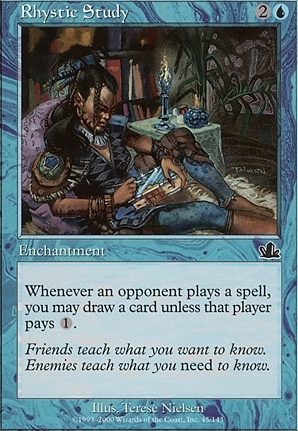
Current price (Prophecy printing): ~$37 to $50
If you’ve ever played a game of Commander, you’ve heard the phrase “Do you pay the one?” Rhystic Study is arguably the most iconic blue enchantment in the format, and it was originally printed as a common in Prophecy back in 2000.
For three mana (2U), Rhystic Study sits on the battlefield and triggers whenever an opponent casts a spell. Unless they pay an additional one colorless mana, you draw a card. In a four-player Commander game, that means three opponents are each giving you potential card draw every single turn. It’s not unusual to draw seven or more extra cards before the table decides they need to deal with it.
The Prophecy common printing holds its value because of the combination of absurd Commander demand and relatively low supply from a set that wasn’t opened heavily. Rhystic Study has been reprinted a handful of times, including in Jumpstart (as a rare), Commander’s Arsenal, and a couple of Secret Lair drops. The cheapest reprint version typically runs around $30, which means the original common printing from Prophecy actually sits at a comparable or slightly higher price point, hovering between $37 and $50 depending on condition.
The foil Prophecy printing is in a league of its own, commanding prices north of $280. Rhystic Study is not on the Reserved List, and Wizards has shown willingness to reprint it, but demand has been so consistently massive that even reprints haven’t meaningfully cratered the price of the original.
3. Lotus Petal (Tempest, 1997)
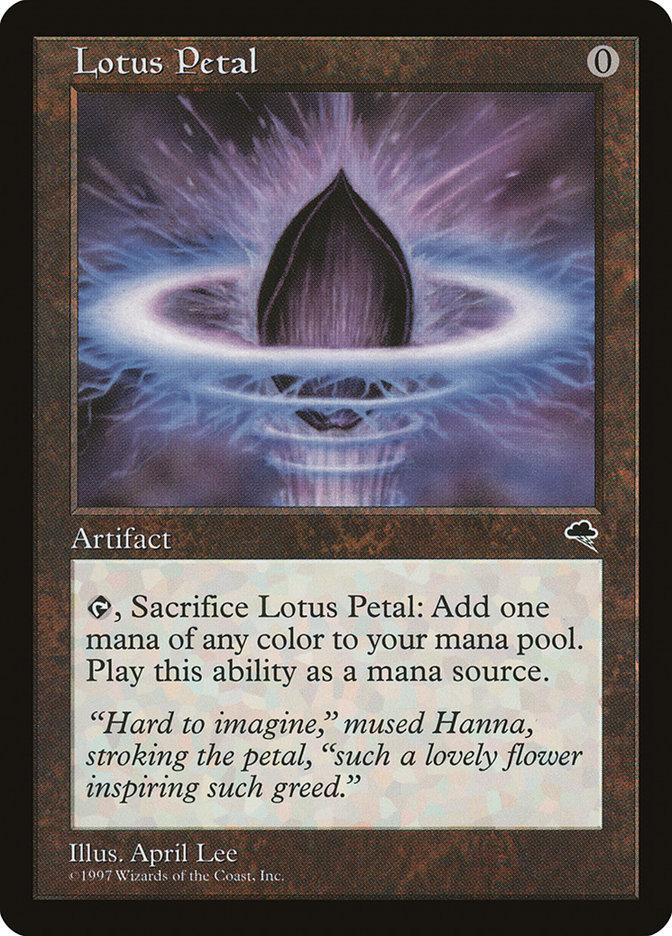
Current price (Tempest printing): ~$28 to $38
Lotus Petal is the little sibling of Black Lotus, and it’s one of the most powerful commons ever printed. It’s a zero-mana artifact that you can sacrifice to add one mana of any color. Free mana acceleration in Magic is always broken, and Lotus Petal has the resume to prove it.
Originally printed as a common in Tempest in 1997, Lotus Petal is restricted in Vintage (meaning you can only play one copy), legal in Legacy (where it’s a staple of combo decks like Sneak and Show and Storm), legal in Pauper, and legal in Commander. It was banned in Extended for years and continues to be one of the most played mana sources in eternal formats.
The Tempest printing currently sells for around $28 to $38 for a near-mint copy. It has not been reprinted in a Standard-legal set, though it appeared in the MTGO-only Tempest Remastered and as a Masterpiece Series card. It is not on the Reserved List, which means a reprint is technically possible, but Wizards has been very cautious about putting free mana acceleration into new products.
The card’s all-time low was around $3 back in the early 2010s, and it has climbed steadily since then as Commander’s popularity exploded and Legacy demand held firm. If you have Tempest-era Lotus Petals sitting in a box somewhere, those are real money cards.
4. Sinkhole (Alpha/Beta/Unlimited, 1993)
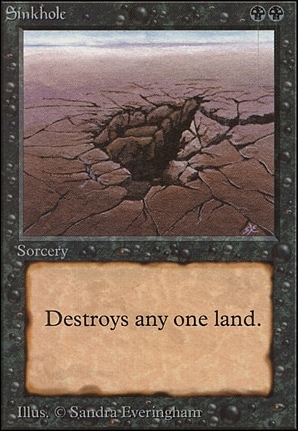
Current price (Alpha): ~$180 | (Beta): ~$89 | (Unlimited): ~$25 to $35
Sinkhole is one of the most efficient land destruction spells ever printed. For just BB (two black mana), you destroy any target land. No restrictions, no additional costs. Compare that to every land destruction spell printed since then, which almost always costs at least three mana. Sinkhole set a power bar in 1993 that Wizards has never come close to again.
It was printed as a common in Alpha, Beta, and Unlimited Edition, making it one of the original commons from Magic’s very first sets. The Alpha printing commands around $180, while Beta copies sit near $89. Even Unlimited copies, with their white borders, still fetch $25 to $35.
Sinkhole was reprinted at rare in Eternal Masters (2016) and has also appeared as a Judge Promo. It is not on the Reserved List. (Commons and uncommons from Alpha and Beta were removed from the Reserved List in the 2002 revision.) The Eternal Masters version can be found for around $5 to $7, which is a much more accessible entry point.
In terms of competitive play, Sinkhole sees occasional Legacy play in black-based control and prison strategies. It’s also popular in Old School Magic (93/94 format), where it’s an absolute house. The Alpha and Beta printings carry significant collector premiums beyond just their gameplay value, as early Magic printings are increasingly treated as collectibles and investment pieces.
5. Zodiac Rat (Portal Three Kingdoms, 1999)
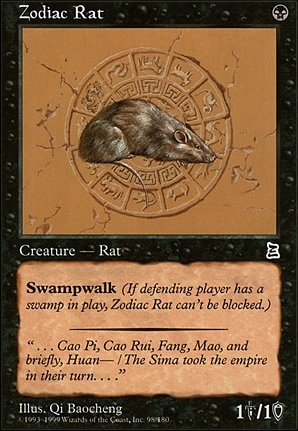
Current price: ~$38 to $52
Here’s where the list gets interesting. Zodiac Rat is a 1/1 black creature for one mana with Swampwalk. That’s it. By any gameplay standard, this is a terrible card. You would never put Zodiac Rat in a competitive deck in any format. It’s a functional reprint of Plague Beetle from Urza’s Legacy, a card worth approximately nothing.
So why is Zodiac Rat worth $38 to $52?
One word: Portal Three Kingdoms.
Zodiac Rat has never been reprinted. Its only printing is the common from PTK, a set with an infamously small English print run. The twelve Zodiac creatures in the set represent the Chinese zodiac, and their flavor texts form a complete poem extracted from the epic Chinese novel Romance of the Three Kingdoms. Each Zodiac creature is a collector’s item purely because of the set’s extreme scarcity.
This is a card where the price is 100% driven by supply rather than demand. Almost nobody wants to play with Zodiac Rat. But the handful of Portal Three Kingdoms collectors and completionists who need one are competing over an incredibly tiny pool of available copies. That scarcity floor keeps the price stubbornly high.
For sellers, Zodiac Rat is actually a great example of why you should always check your old collections carefully. A card that looks like bulk can be worth serious money if it’s from the right set.
6. Darkness (Legends, 1994)
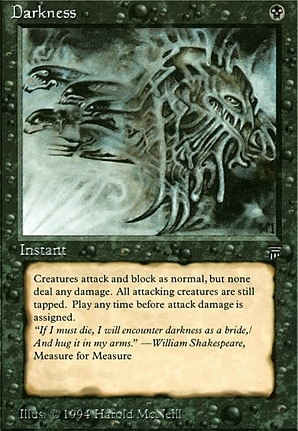
Current price (Legends printing): ~$13 to $17
Darkness is essentially a black Fog. For a single black mana, it prevents all combat damage that would be dealt that turn. In a color that doesn’t usually get access to Fog effects, Darkness fills a unique niche.
It was originally printed as a common in Legends, a 1994 set that is famous for its relatively low print run (especially compared to Revised and Fourth Edition, which flooded the market around the same time). Legends commons don’t carry the same premium as Legends rares (looking at you, Tabernacle at Pendrell Vale), but the set’s overall scarcity means that even commons hold a price floor that most cards from the era can’t match.
Darkness has been reprinted twice. It appeared in the Time Spiral “Timeshifted” subset in 2006, where it was printed with the old-border treatment as a “special” rarity. It was also reprinted in the Warhammer 40,000 Commander decks. Despite those reprints, the Legends original still holds its value at $13 to $17 because of collector demand for the original printing.
Darkness is not on the Reserved List. It sees some play in Pauper sideboards and occasional Commander builds that lean into black defensive strategies. It’s one of only a few combat damage prevention effects in black’s slice of the color pie, which gives it a certain uniqueness that keeps players coming back to it.
7. Zodiac Rooster (Portal Three Kingdoms, 1999)
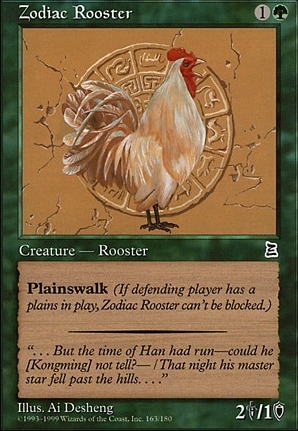
Current price: ~$15 to $25
Zodiac Rooster is a 2/1 green creature for 1G with Plainswalk. Like Zodiac Rat, this is not a card anyone is putting in a competitive deck. Plainswalk is one of the rarest and least useful landwalk abilities in Magic. (For the record, Zodiac Rooster is only the second creature ever printed with Plainswalk, after Righteous Avengers from Legends.)
The price, again, comes entirely from Portal Three Kingdoms scarcity. Zodiac Rooster has never been reprinted. It exists in exactly one printing, from a set that was barely distributed in English. The creature type is technically “Bird” now (it was originally printed as “Creature – Chicken,” which is a fun piece of MTG trivia).
At $15 to $25, Zodiac Rooster sits a bit below Zodiac Rat in the pricing hierarchy, likely because Rat is a more collectible creature type among tribal enthusiasts. But make no mistake, this is still a $15+ common with zero competitive demand. Pure scarcity premium.
Zodiac Rooster is not played in any current competitive format. It’s not on the Reserved List, but the chance of Wizards reprinting a vanilla 2/1 with Plainswalk in a future set is essentially zero. This is as close to a “forever rare” common as it gets.
8. Ashnod’s Altar (Chronicles, 1995)
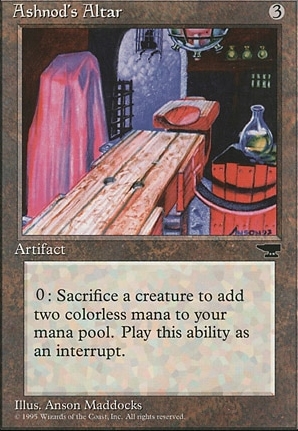
Current price (Chronicles common): ~$7 to $10
Ashnod’s Altar is a card every Commander player knows. It’s a three-mana artifact that lets you sacrifice a creature to add two colorless mana. It’s one of the most versatile sacrifice outlets in the game and goes infinite with a laughably long list of combos. If you play black, green, or really any color in Commander, Ashnod’s Altar has probably been in one of your decks at some point.
The card was originally printed as an uncommon in Antiquities (1994), but it was reprinted as a common in Chronicles (1995). That Chronicles common printing is the version that qualifies it for this list, and it currently sells for around $7 to $10.
Ashnod’s Altar has been reprinted many times since then, including in Sixth Edition, Eternal Masters, and several Commander preconstructed decks. Newer printings are typically $4 to $6. But the Chronicles version holds a slight premium because of its age, the original Anson Maddocks artwork, and the collector appeal of white-bordered early printings.
Notably, Ashnod’s Altar is also legal in Pauper (since it has a common printing), where it occasionally appears in combo-oriented builds. It is not on the Reserved List. The card’s value is primarily driven by relentless Commander demand rather than scarcity. According to EDHREC, it appears in tens of thousands of Commander decklists. This is one common where reprints have barely dented the price because the player base just keeps growing.
9. Culling the Weak (Exodus, 1998)
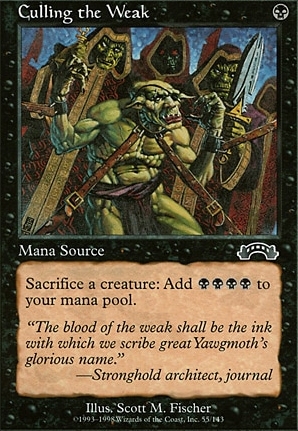
Current price: ~$10 to $12
Culling the Weak is a black instant from Exodus that costs a single black mana. As an additional cost, you sacrifice a creature, and in return you add four black mana (BBBB) to your mana pool. Read that again. One mana in, four mana out. That’s Dark Ritual on steroids, with the downside of requiring a creature to eat.
In Commander, where token generators are everywhere and sacrifice synergies are a core strategy for black decks, Culling the Weak is a powerhouse. It enables explosive turns where you sacrifice a creature you were going to lose anyway and suddenly have enough mana to cast your game-ending spell three turns ahead of schedule.
Here’s the kicker: Culling the Weak has never been reprinted. Not once. Its only printing is the Exodus common from 1998. That’s nearly three decades of Commander growth, Pauper interest, and general format expansion with a completely fixed supply. The card is not on the Reserved List (Exodus commons weren’t added), so a reprint is theoretically possible, but Wizards hasn’t gotten around to it yet.
At $10 to $12, Culling the Weak is actually one of the more affordable cards on this list. But for a common from a mid-90s set, that price is remarkable. It’s the kind of card that sits in old collections unnoticed because it’s “just a common” until someone checks the price and does a double take.
10. False Defeat (Portal Three Kingdoms, 1999)
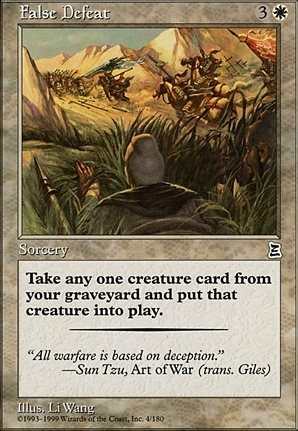
Current price: ~$13 to $20
False Defeat rounds out our list as the fourth Portal Three Kingdoms card in the top 10, which tells you everything about how much that set’s scarcity drives the secondary market. False Defeat is a white sorcery costing 3W that returns a creature card from your graveyard to the battlefield. It’s a functional reprint of Resurrection, a card that has been printed many times and is worth virtually nothing.
False Defeat has never been reprinted. It is the only printing of this card. That single Portal Three Kingdoms common printing is all that exists, and it sells for $13 to $20 depending on condition and language (Chinese and Japanese copies tend to be slightly cheaper than English ones, given that the set was primarily printed in Asian languages).
The card’s flavor text quotes Sun Tzu’s Art of War: “All warfare is based on deception.” Fitting, since the card’s price tag might deceive you into thinking it does something special. It doesn’t. It’s a four-mana reanimation spell at sorcery speed. The value is entirely about the set it came from.
False Defeat is legal in Commander, Legacy, Pauper, and Vintage. It is not on the Reserved List. There’s essentially no competitive demand for this card. If you own one, its value is as a collector’s piece from one of Magic’s rarest sets.
What These Cards Have in Common (Pun Intended)
Looking at this list, a few patterns jump out.
Portal Three Kingdoms dominates. Four of the ten most expensive commons come from a single set that most Western players have never even seen in person. When English copies of a set are primarily distributed to Australia and New Zealand in 1999, you end up with a permanent scarcity premium that has only grown over the decades.
Early sets hold value. Alpha, Beta, Legends, Antiquities, Tempest, Exodus, Prophecy. These are all sets from Magic’s first decade, when print runs were smaller and the game’s long-term staying power wasn’t yet a certainty. Cards from this era have a built-in scarcity advantage.
Reprints help but don’t eliminate the original’s value. Three Visits, Rhystic Study, Sinkhole, Darkness, and Ashnod’s Altar have all been reprinted at least once. In every case, the original common printing still commands a premium over the reprint. Collectors want the original, and that demand floor stays firm.
Format demand amplifies scarcity. The most expensive cards on this list (Three Visits, Rhystic Study, Lotus Petal) are all heavily played in Commander, Legacy, or Pauper. When a scarce card is also in high demand from competitive players, the price ceiling goes up dramatically.
How to Actually Sell These Cards
If you’re looking at this list and realizing you might have some of these cards in your collection, the next step is getting them listed. Cards in this price range are absolutely worth the time to sell individually on eBay rather than buylisting them. A buylist might offer you $8 for a $30 card. Listing it yourself means keeping most of that value.
The challenge, as always, is the listing process. Photographing, writing titles, setting item specifics, pricing against recent sold comps on eBay. If you have a handful of expensive commons, it’s manageable by hand. But if you’ve got a larger collection with dozens or hundreds of cards in that “$5 to $50” sweet spot, the manual listing grind gets old fast.
That’s exactly the problem MTG Bulk Caster was built to solve. You export your collection from Manabox, Archidekt, or Moxfield as a CSV, import it into Bulk Caster, and the tool matches your cards against its database. It pulls card images, maps eBay categories, fills in item specifics, and lets you set batch pricing rules. Then it exports an eBay-compatible CSV file you can bulk upload directly. What used to take an entire weekend of manual data entry takes minutes.
For cards like the ones on this list, you’ll probably want to add individual photos and double-check condition grading since buyers at this price point scrutinize listings more carefully. Shipping high-value singles safely is also important. Make sure you’re using quality top loaders and bubble mailers for anything over $20. But for everything in your collection that falls in the $2 to $20 range? Bulk Caster handles the heavy lifting so you can focus on the high-value singles.
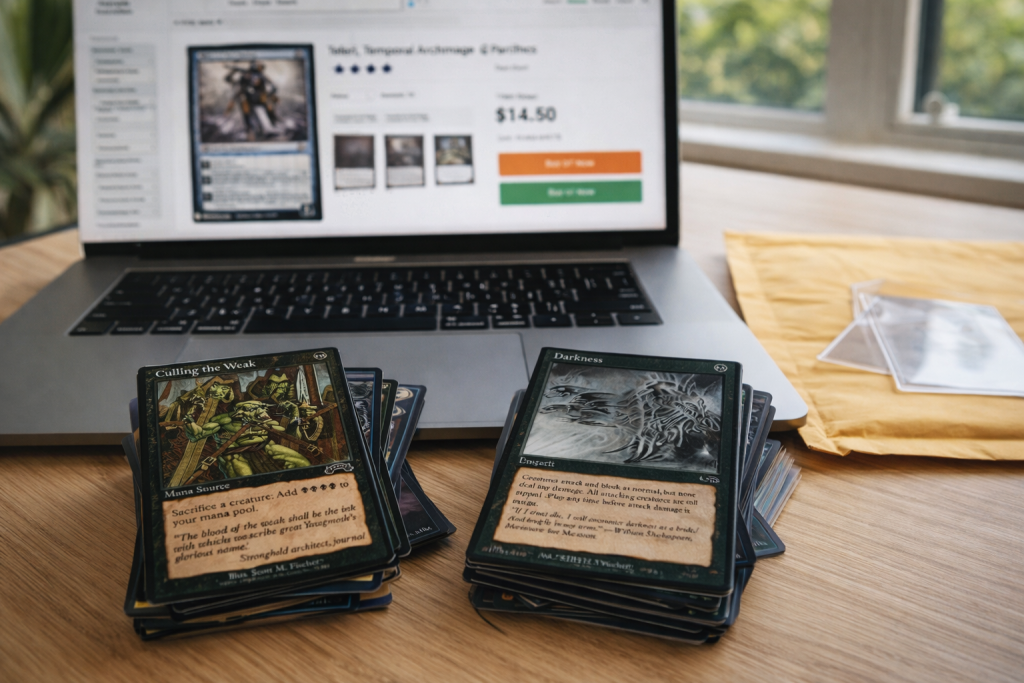
The Lesson for Sellers
The biggest takeaway from this list is simple: don’t assume commons are worthless. Most are. But the exceptions are worth enough to justify checking before you dump everything into a bulk box. A quick scan through a collection app like Manabox will flag any commons with surprising value, and from there you can decide whether to list them individually or bundle them into your next MTG Bulk Caster batch.
You don’t need to memorize this list. You just need a system that catches the cards worth selling before they end up in a 5,000-count box headed to a buylist for $3 per thousand.