
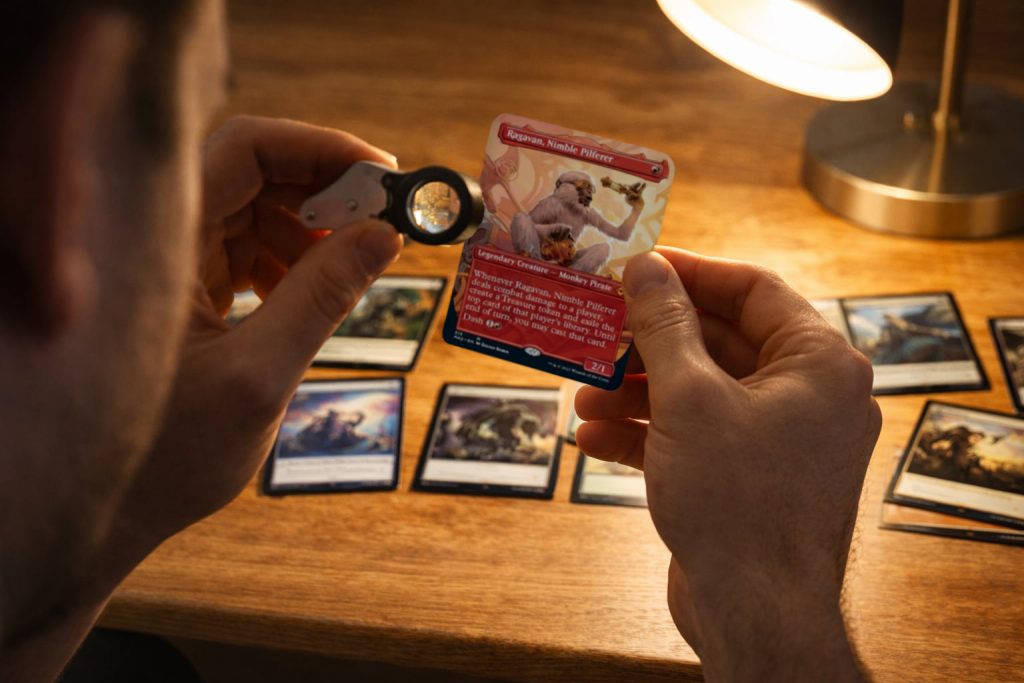
Knowing how to spot fake Magic the Gathering cards is one of the most important skills you can develop as a player, collector, or reseller. Counterfeits have flooded the secondary market in recent years, and they are getting better. Not “good enough to fool a veteran” better, but definitely “good enough to fool someone buying their first dual land on eBay” better. And that is a problem.
I have handled thousands of Magic cards as both a player and an eBay seller. I have caught fakes in trade binders at my LGS, in lots I purchased to flip, and even in cards friends brought over for me to check. Learning how to spot fake Magic the Gathering cards came down to knowing what to look for and having the right tools within arm’s reach.
This guide covers 8 reliable tests that explain how to spot fake Magic the Gathering cards, from quick no-tool checks you can do at the card shop counter to magnification tests that are nearly foolproof. No single test is 100% definitive on its own. The goal is to stack multiple tests together and build a case. If a card passes all of them, you are almost certainly holding the real thing. If it fails even one, it is time to dig deeper.
Why Fake Magic the Gathering Cards Are a Bigger Problem Than You Think
Counterfeiting is not just a problem for people buying Power 9 and Reserved List staples. That is a common misconception. If you want to know how to spot fake Magic the Gathering cards, you need to understand that fakes of $5 to $20 cards are now extremely common on eBay, Facebook groups, and local meetups. Nobody scrutinizes a $10 card the way they would a $500 card, so counterfeiters can move large volumes with less risk of being caught.
It is worth understanding the difference between a counterfeit and a proxy. A proxy is a stand-in card clearly not intended to deceive anyone. Writing “Ragavan” on a basic land with a Sharpie so you can test a deck is a proxy. A card printed on fake card stock designed to pass as a genuine Ragavan, Nimble Pilferer so you can sell it for $50 is a counterfeit. Intent to deceive is the line.
Wizards of the Coast takes counterfeiting seriously. Using known counterfeits in sanctioned tournament play can result in disqualification or a ban from all future competitive events. For sellers, listing counterfeit cards as genuine violates marketplace policies and potentially copyright law.
The Tools You Will Need
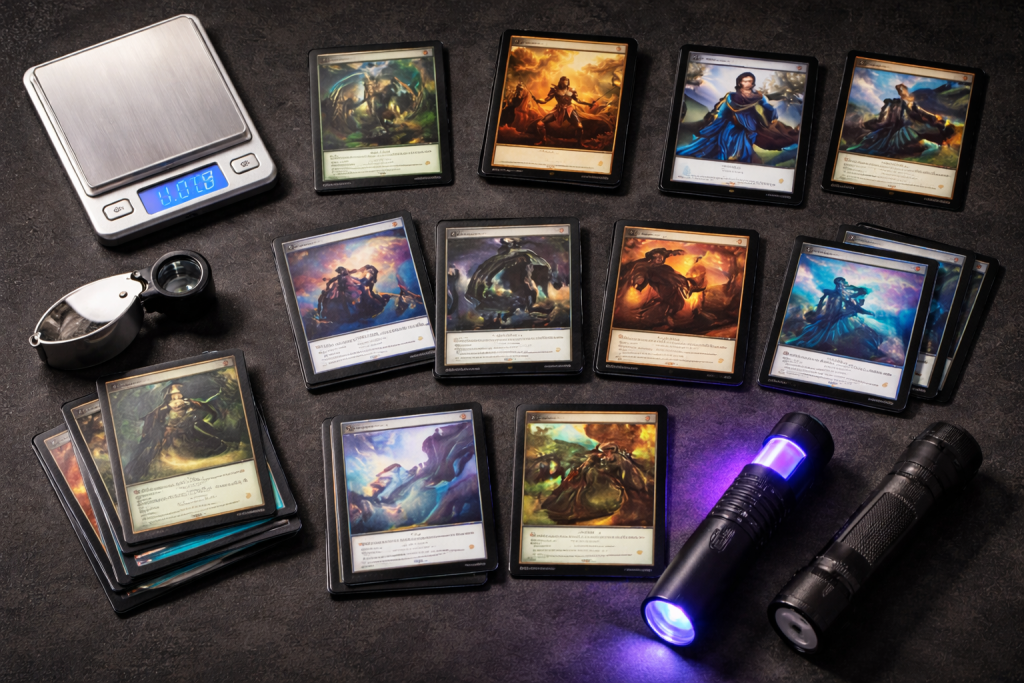
Before getting into the tests, let’s talk about gear. Knowing how to spot fake Magic the Gathering cards is only useful if you have the right tools handy. You do not need an expensive setup. Here is what I recommend keeping in your trade bag or on your desk.
A jeweler’s loupe with at least 30x magnification is the single most important tool. You can find perfectly good ones on Amazon for $10 to $15. This is non-negotiable if you are buying cards worth more than a few dollars. A smartphone flashlight is all you need for the light test, and you already have one. A precision scale that reads to 0.01 grams is helpful for the weight test. Jeweler’s scales run about $10 to $15 and are small enough to keep in a bag. A UV flashlight (blacklight) is optional but useful as a supplemental check. You can get one for under $10.
That entire kit runs about $30 to $40 total. If you are spending any real money on Magic singles, it pays for itself the first time it helps you avoid a fake.
8 Ways to Spot Fake Magic the Gathering Cards
1. The Feel Test (No Tools Required)
This is the first line of defense and the one veteran players rely on most. When learning how to spot fake Magic the Gathering cards, your fingers are often the first tool that catches something wrong. If you have handled hundreds or thousands of genuine Magic cards, your fingers already know what “right” feels like.
Genuine Magic cards have a slightly textured, matte finish. Fakes often feel noticeably different. Some feel waxy or plasticky. Others feel too smooth or have an odd glossiness that is immediately off-putting to experienced hands.
The best way to perform the feel test is to compare the suspect card against a known genuine card from the exact same set. A basic land from the same expansion works perfectly. Shuffle them together and see if one card feels like it does not belong. If it slides differently, has a different stiffness, or just feels “off,” that warrants further testing.
Keep in mind that legitimate cards do vary. Cards from Collector’s Boosters can feel slightly thicker than Standard Booster cards. Japanese printings have a different matte finish compared to European printings. Older sets used different paper mills with different grain directions. This is why the feel test alone is never conclusive, but it is a fast first filter.
2. The Light Test (Phone Flashlight Required)
This is one of the most accessible tests, and you can do it anywhere with a phone. Genuine Magic cards are printed on specialty card stock that contains a blue-dyed core layer sandwiched between the front and back printed surfaces. Cartamundi, the company that prints Magic cards, uses a proprietary paper called “Corona” that gives the card stock its distinctive layered structure.
To perform the light test, press your phone’s flashlight directly against the back of the card in a dim room. On a genuine card, light passes through with a noticeable bluish hue from the blue core. The key thing to look for is that you can easily see the card art when looking from the back, including the text box area. The artwork and card layout should be visible through the card as a faint, backlit image with an even blue-tinted glow.
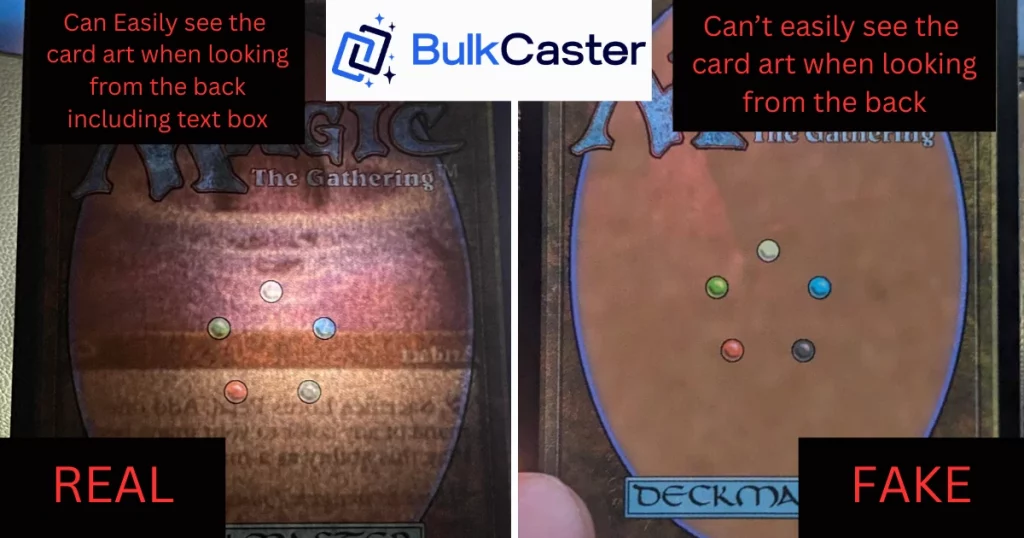
On a fake card, the card stock is typically too opaque. You will not be able to easily see the card art from the back. The light is blocked or muffled, and you either see almost nothing through the card or the light that does pass through looks flat and washed out without that characteristic blue hue.
There are important caveats. Always compare against a known genuine card from the same set and color, because the amount of light that passes through varies depending on the card’s age, print run, and colors on the face. Three for One Trading’s counterfeit guide has great side-by-side photos showing the range of results you can get from genuine cards alone.
Foil cards naturally block more light due to their metallic layer, making this test unreliable for foils. And a few specific printings, like certain Ixalan double-faced cards, were printed on incorrect card stock by Wizards of the Coast themselves and will fail the light test despite being legitimate. The light test is not perfect, but it is one of the fastest ways to learn how to spot fake Magic the Gathering cards without any special equipment.
3. The Green Dot Test (Loupe Required)
This is one of the most reliable tests in the entire hobby, and it is the test I recommend first to anyone asking how to spot fake Magic the Gathering cards. On the back of every Magic card, there are five small circles representing the five colors of mana. The green circle contains a hidden “fingerprint” that is extremely difficult to counterfeit.
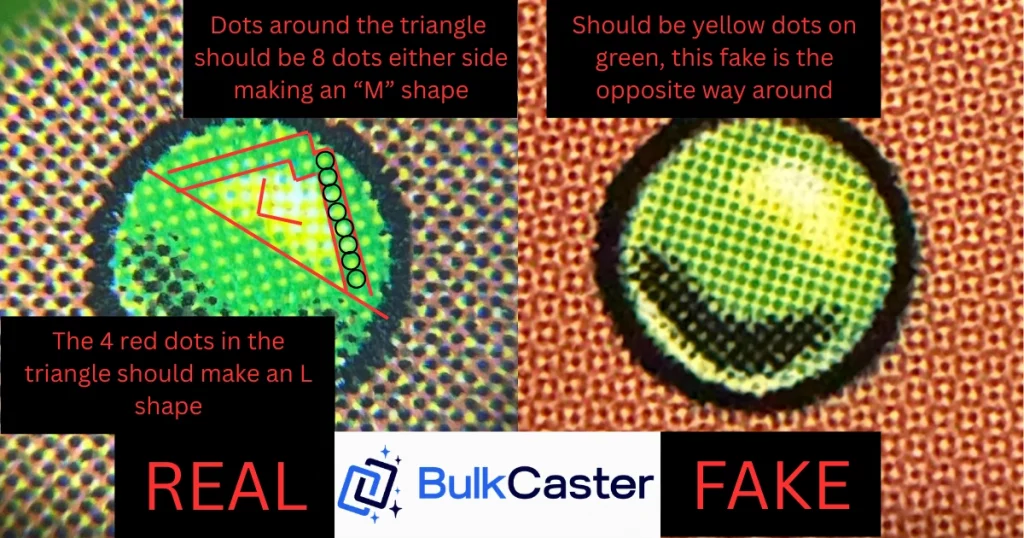
When you examine the green mana circle under 30x or higher magnification, there are three specific things to look for on a genuine card:
The L-shaped red dots. Inside the yellowish area of the green circle, you should see four tiny red (magenta) dots that form a recognizable upside-down “L” shape. This pattern exists because of how Wizards of the Coast separates their color layers during the printing process.
The M-shaped dot border. Look at the dots surrounding the triangular yellow area within the green circle. On a genuine card, there should be approximately 8 dots on either side of this triangle, forming a distinctive “M” shape along the border. Fakes either miss this detail entirely or get the count and shape wrong.
Yellow dots on green. On a genuine card, the color relationship inside the green mana circle is yellow dots printed on a green background. Many fakes get this reversed, showing green dots on a yellow background. It is a subtle difference, but under magnification it is immediately obvious when you know to look for it.
This “L” pattern and the surrounding dot structure have been present on every genuine Magic card since Alpha. Replicating it would require a counterfeiter to either obtain the original Wizards of the Coast print files or painstakingly adjust their own color separation files across every single ink layer. The time and precision required make it nearly impossible to fake convincingly. For an even deeper dive on this test, Detecting the Fakes has excellent reference photos.
One major caveat: the green dot test will not catch “rebacked” cards, which are counterfeits made by peeling the back off a genuine cheap card and gluing it onto a fake front. Since rebacked cards use genuine card backs, the green dot will pass. For rebacked cards, the weight test and light test are more effective.
4. The Rosette Pattern Test (Loupe Required)
Understanding the rosette pattern is essential to learning how to spot fake Magic the Gathering cards under magnification. Magic cards are printed using offset lithography, which produces images through thousands of tiny ink dots layered at specific angles. Under magnification, these dots form a distinctive flower-like pattern called a rosette. This pattern is the fingerprint of genuine offset printing.
When you examine a genuine card under a loupe, you should see clean, circular rosettes with dots that are crisp and evenly spaced. The dots are created by layering cyan, magenta, yellow, and black ink at precise angles. Each color layer has its own dot angle, and where they overlap, they create the rosette.
Counterfeit cards are typically produced from scanned images of genuine cards, then reprinted using digital or inkjet processes. These printing methods produce fundamentally different dot patterns. Instead of clean rosettes, you will see blurry, irregularly shaped dots, a grid-like pattern, or dots that appear smudged and chaotic. The difference is obvious once you know what to look for.
The rosette pattern varies between sets and even between print runs of the same set. That is normal. What matters is that the pattern exists and looks like it was produced by offset printing rather than a consumer-grade digital press.
5. The Black Ink Overprint Test (Loupe Required)
This is closely related to the rosette test and is one of the most reliable tells under magnification. When Wizards of the Coast prints Magic cards, the artwork and colored backgrounds are printed first using the CMYK dot method. Then, in a final separate pass, solid black ink is laid down on top for all the card’s text, mana symbols, card frame borders, and expansion symbols.
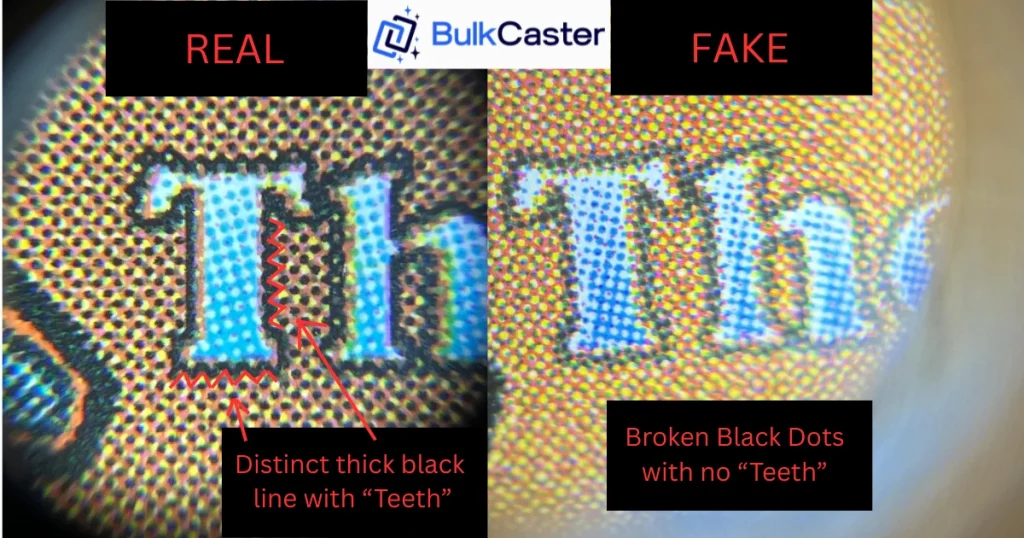
On a genuine card under magnification, you will see distinct, thick black lines with “teeth.” Those teeth are the telltale sign of real offset printing. Where the solid black ink meets the colored rosette pattern underneath, the edge of the black line has a sharp, serrated appearance, almost like tiny jagged teeth running along its border. The black is solid and opaque, sitting cleanly on top of the colored dots beneath it. The text is crisp, and you can clearly see where one printing layer ends and the other begins.
On a counterfeit card, you will see broken black dots with no teeth. Because everything is printed in a single pass on fakes, the “black” areas are not solid at all. They are made up of scattered colored dots attempting to simulate black, and there is no clean separation between the text layer and the background. Under a loupe, the letters look fuzzy and fragmented, and the edges are soft and blended rather than having that sharp, serrated bite.
This is the test that has the highest success rate in my experience. If you only learn one loupe technique for how to spot fake Magic the Gathering cards, make it this one. I have yet to encounter a fake that nails this black line separation correctly. Consumer-grade printers simply cannot replicate the two-pass offset printing process.
6. The Weight Test (Precision Scale Required)
Genuine Magic cards have a remarkably consistent weight. A standard non-foil card weighs between 1.7 and 1.8 grams. Foil cards are slightly heavier, typically between 1.9 and 2.0 grams.
Counterfeit cards frequently fall outside this range because they use different card stock. Many fakes weigh around 1.9 grams or higher for non-foil cards, because the materials used tend to contain more plastic or thicker paper than genuine card stock.
To get the most out of this test, weigh the suspect card against a known genuine card from the same set. The absolute number on your scale can be influenced by humidity, calibration, and other factors, so a direct comparison is more reliable than checking against a general reference number. If the two cards differ by more than 0.05 grams, that is a red flag.
This test is fast and easy, but not conclusive on its own. Newer “blue core” counterfeits have gotten closer to the correct weight range, so it works best as a supplemental check alongside the loupe and light tests. Still, anyone serious about learning how to spot fake Magic the Gathering cards should keep a precision scale in their toolkit.
7. The Hologram Stamp Check
Starting with Magic 2015 (released in July 2014), Wizards of the Coast added a small oval holofoil security stamp to all rare and mythic rare cards. This stamp appears at the bottom center of the card, just below the text box.
On a genuine card, the hologram is embedded directly into the card and sits flush with the surface. When you tilt the card under light, the stamp shifts between showing a planeswalker symbol and small mana icons. The edges of the stamp are clean and even.
Early counterfeit holograms were obviously fake. They looked like stickers applied after printing with rough edges and zero detail. Modern counterfeits have improved. Some now feature holofoil stamps that are surprisingly convincing at first glance, including planeswalker symbols.
However, there are still key differences to watch for under a loupe. Genuine stamps display clean micro-printed symbols that are sharp and legible under magnification. Many fakes show a repeating “WIZARDS WIZARDS” text pattern that is not present on real stamps. Fake stamps may sit slightly raised from the card surface, while genuine ones are smoothly integrated. If the stamp looks tampered with, peeling at the edges, or misaligned from center, treat it as suspicious.
This test only applies to rares and mythics from 2015 onward. Commons and uncommons do not have hologram stamps. Certain special products use different stamp shapes as well. Universes Beyond cards use a triangular stamp, Signature Spellbook cards use a circle, and Unfinity “acorn” cards have their own distinctive shape. Knowing these variations is part of understanding how to spot fake Magic the Gathering cards across different product lines.
8. The UV Light Test (Blacklight Required)
Under ultraviolet light, genuine Magic cards fluoresce in a specific way that differs from most counterfeits. The card stock used by Cartamundi reacts to UV light with a particular glow pattern, while fakes printed on different paper stocks either do not fluoresce at all or fluoresce differently.
Shine a UV flashlight on the suspect card alongside a known genuine card from the same set. Compare how they react. On most genuine cards, the back reflects UV light fairly uniformly, with the logo, symbols, and frame lines sometimes appearing brighter depending on the angle.
This is a supplementary test, not a primary one. UV fluorescence varies between sets and print runs, and some counterfeits have gotten better at mimicking it. I would never authenticate a card based on UV alone, but when you are learning how to spot fake Magic the Gathering cards, every additional data point helps build your case.
Tests You Should Avoid
Two quick notes on popular tests that I do not recommend. Part of knowing how to spot fake Magic the Gathering cards is also knowing which methods to skip.
The Bend Test involves flexing a card sharply to see if it creases or bounces back. The problem is that this is destructive, modern counterfeits can pass it, and you risk permanently damaging a real card for no reason.
The Rip Test involves tearing a card to check for the blue core layer inside. Obviously destructive and completely unnecessary. The light test gives you the same structural information without destroying the card.
How to Spot Fake Magic the Gathering Cards When Buying Online
All of the tests above require you to physically hold the card. That is a problem when buying on eBay, Facebook Marketplace, or trade groups. Knowing how to spot fake Magic the Gathering cards before you buy means applying some preventive strategies when shopping remotely.
Buy from reputable sellers. On eBay, stick to sellers with thousands of positive feedback and established track records. On TCGPlayer, the platform’s buyer protection and internal authentication processes significantly reduce risk. Established card shops like Card Kingdom and ABUGames verify their inventory.
Scrutinize new or low-feedback sellers. A brand new eBay account with zero feedback listing a Revised dual land should be a massive red flag. The combination of a new account and a high-value card warrants extreme caution.
If the price seems too good to be true, it is. A Ragavan for 40% below TCG Low is not a deal. It is a trap.
Ask for detailed photos. Request close-up images of the card’s front, back, and hologram stamp. A legitimate seller has no reason to refuse this.
Use buyer protection. eBay’s Money Back Guarantee covers counterfeit cards under “Item Not as Described” regardless of the seller’s return policy. TCGPlayer has similar buyer safeguard protections. Always pay through the platform.
When you receive a card, test it immediately using the methods in this guide. Knowing how to spot fake Magic the Gathering cards after they arrive is your last line of defense.
Why This Matters for MTG Resellers
If you are selling Magic cards on eBay, knowing how to spot fake Magic the Gathering cards is not optional. Listing a counterfeit, even unknowingly, puts your seller account at risk. Buyers will open cases, leave negative feedback, and you will be on the hook for refunds.
This is one of the reasons I built MTG Bulk Caster. When you are listing hundreds of cards at a time, you want every card in your inventory verified as genuine before it goes into a listing. The listing process itself is fast once you are confident in your inventory. MTG Bulk Caster handles the tedious part of getting your cards formatted and uploaded to eBay, but the authentication step before that point is on you.
If you are piecing out a collection or picking bulk for above-bulk value, always spot-check any card worth more than a few dollars. Run it through the light test and a quick loupe check. It takes 30 seconds per card. Once you know how to spot fake Magic the Gathering cards at a glance, this becomes second nature and saves you from accidentally selling a fake.
Think of authentication as a standard step in your reselling pipeline, right alongside grading and pricing. Once you know how to spot fake Magic the Gathering cards, you can build that check into your workflow with confidence. MTG Bulk Caster handles the listing side. This guide handles the authentication side. Together, they cover the full workflow from collection to cash.
Quick Reference: The Authentication Stack
Here is my recommended order of operations for how to spot fake Magic the Gathering cards quickly. Start fast, then escalate if anything seems off.
Step 1: Feel it. Does the card feel right compared to others from the same set? Two seconds. Catches a surprising number of fakes.
Step 2: Light test. Shine your phone flashlight through the card. Can you see the card art from the back with a blue hue? Five seconds.
Step 3: Loupe check. Examine the green dot for the red “L” pattern and “M” shaped dot border. Check the black text for thick solid lines with teeth. Look at the rosette pattern. Thirty to sixty seconds.
Step 4: Weight. Put it on the scale and compare to a known genuine card. Ten seconds.
Step 5: Hologram (if applicable). Check the security stamp on rares and mythics from 2015 onward. Tilt under light, examine under loupe. Fifteen seconds.
No single test is foolproof. Stack them. That is the core principle of how to spot fake Magic the Gathering cards with confidence. If a card passes all five steps, you can be highly confident it is genuine. If it fails even one, investigate further before buying or listing it.