
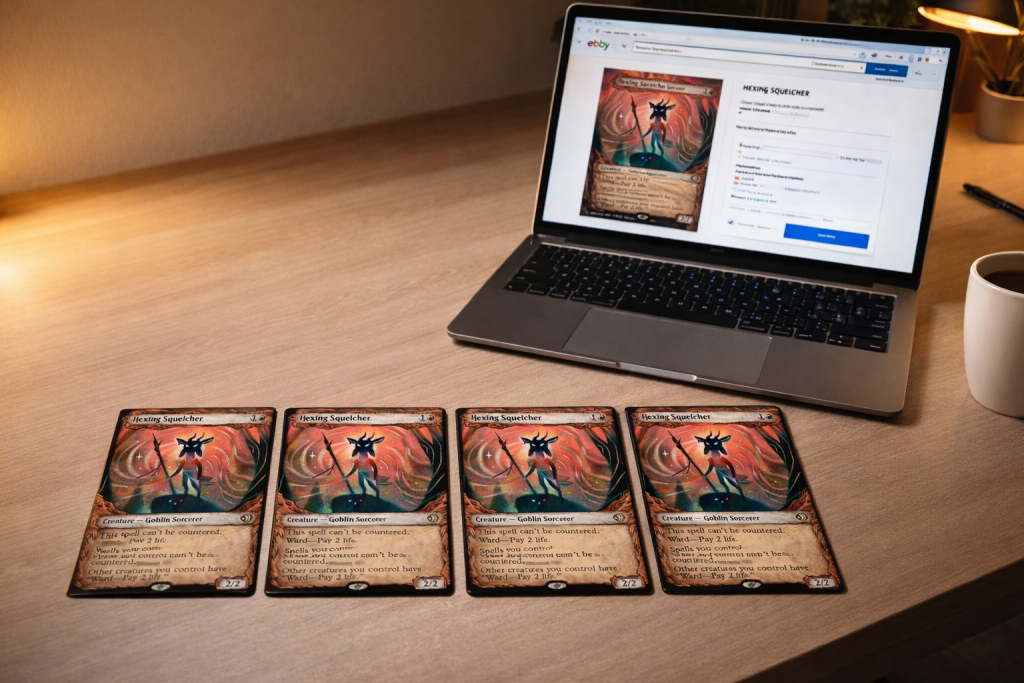
If you have a pile of mtg standard legal cards sitting in a box and you want to turn them into cash, selling them as playsets of four on eBay is one of the fastest ways to do it. Most Standard cards fall into that awkward price range where they’re worth too much to dump at buylist prices but not enough to justify listing each one individually. Selling in sets of four solves that problem, and in this guide I’ll walk you through exactly how to do it.
I’m Jake, and I’ve shipped thousands of MTG singles on eBay over the years. The playset strategy is one I wish I’d started using sooner, because it genuinely changed how fast I move inventory. Let me show you why it works and how to set it up.
What Makes a Card Standard Legal (and Why It Matters for Selling)
Standard is one of Magic: The Gathering’s flagship constructed formats. It uses a minimum 60-card deck built from the most recently released sets, and players can include no more than four copies of any single card other than basic lands. Sets typically remain Standard legal for up to three years before they rotate out.
Standard is also the format most commonly found at Friday Night Magic tournaments, which are played weekly at hobby shops and game stores around the world. Thousands of WPN (Wizards Play Network) stores host these events every Friday, which means there is constant demand for Standard legal cards from players building and updating their decks.
As of early 2026, the Standard card pool includes sets from Wilds of Eldraine forward, plus Foundations (which remains Standard legal through at least 2029). Wizards of the Coast skipped the 2026 fall rotation, and starting in 2027, rotation will shift to align with the first set release of each calendar year instead of the traditional fall rotation.
Here is the key takeaway for sellers: Standard legal cards have a built-in buyer pool that other formats don’t always guarantee. Competitive players, Friday Night Magic regulars, and Arena players who also play paper all need these cards. And because Standard decks run up to four copies per card, they often want to buy the full playset at once.

Why Playsets of 4 Sell Faster Than Singles
In most constructed Magic formats, deck construction rules allow up to four copies of any non-basic-land card. For Standard specifically, players building competitive decks almost always need the full four copies of their key cards. If someone is building Izzet Prowess and needs four copies of a particular uncommon, they’d rather buy one listing of four cards than hunt down four separate sellers.
Here’s why selling in lots of four works so well for above-bulk Standard cards:
Higher average order value. A card worth $1.50 individually might sit on your eBay store for weeks. Bundle four copies together at $5.00 and a Standard player sees immediate value. They save time, shipping, and hassle compared to buying singles from four different sellers.
Lower per-card listing effort. If you’re listing 200 different Standard cards as singles, that’s 200 listings. Group them into playsets and you’re down to 50 listings covering the same inventory. Each listing takes the same amount of time to create, so you’ve just cut your workload by 75%.
Better sell-through rate. Standard players are the most likely buyers to purchase full playsets because the format demands consistency. A deck running three copies of a card would almost always rather have the fourth in the sideboard or as a backup. This means your playset listings match how buyers actually shop.
Shipping efficiency. Sending four cards costs the same as sending one card if you’re using a PWE (plain white envelope) or eBay Standard Envelope. Four cards in a penny sleeve inside a top loader still fits in a standard envelope. Your shipping cost stays flat while your revenue per package goes up.
Which Standard Cards Are Worth Listing as Playsets
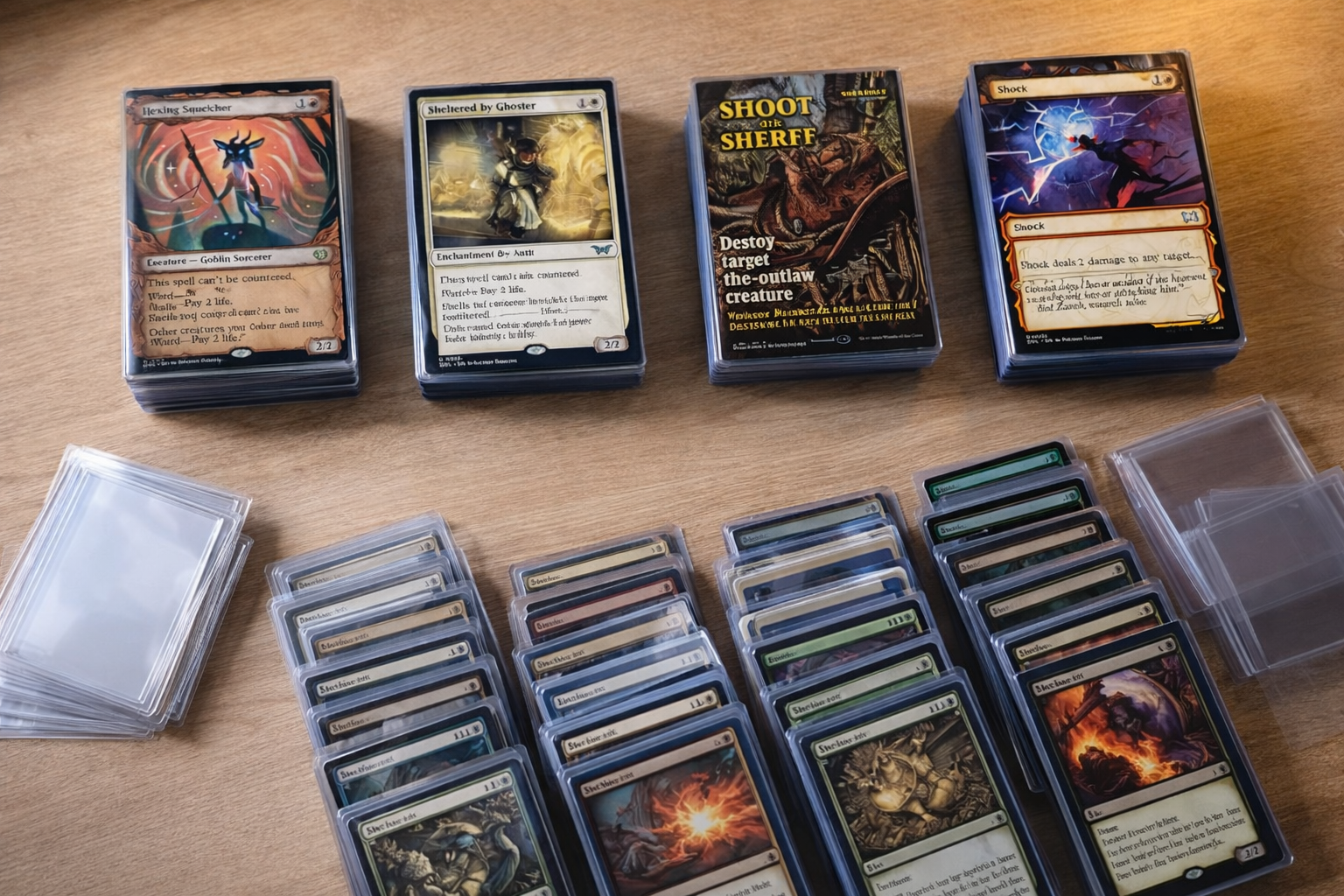
Not every Standard legal card is worth the effort to list, even as a playset. The sweet spot is cards in the $0.50 to $5.00 per-card range. Here’s how I break it down:
Under $0.25 per card: True bulk. Even four copies at $0.25 each only gets you a $1.00 listing, which isn’t worth the eBay fees and shipping materials. Sell these at bulk rates ($3 to $5 per thousand) or include them in larger mixed lots.
$0.25 to $1.00 per card: This is where playsets start making sense. Four copies of a $0.75 uncommon listed at $2.50 to $3.00 is a sale that actually nets you something after fees. Standard staples and sideboard cards often live in this range.
$1.00 to $5.00 per card: The playset sweet spot. Four copies of a $2.00 rare listed at $7.00 to $8.00 is an easy Buy It Now sale. Buyers at this price point are almost always Standard players who need the full set.
$5.00+ per card: These are worth listing individually. At $5.00 and above, the per-card margin justifies the extra listing time. You might also list a playset at a slight discount to move them faster, but individual listings work fine here too.
A number of websites report on tournament results, publish complete decklists for the most popular competitive decks, and feature articles on current strategy and metagame debate. Sites like MTGGoldfish, MTG Decks, AetherHub, and the official Magic.gg decklists page are the best places to check which cards are seeing heavy tournament play. If a card shows up as a three-of or four-of in a top-performing Standard deck, it’s a strong candidate for your playset listings.
How to Identify MTG Standard Legal Cards in Your Collection
If you’re working from a big unsorted collection, you need a reliable way to identify which cards are currently Standard legal. Here are the practical options:
Step 1: Use a collection app. Apps like Manabox, Moxfield, and Archidekt let you scan cards with your phone camera and will flag which ones are Standard legal. Scan your collection, then filter by format legality. This is the fastest way to pull Standard cards out of a large pile.
Step 2: Check set symbols and release dates. If you know which sets are currently in Standard, you can sort by set symbol. As of February 2026, Standard legal sets include Wilds of Eldraine, Lost Caverns of Ixalan, Murders at Karnak Manor, Outlaws of Thunder Junction, Bloomburrow, Duskmourn, Foundations, Aetherdrift, Tarkir: Dragonstorm, Final Fantasy, Edge of Eternities, Marvel’s Spider-Man, Avatar: The Last Airbender, and Lorwyn Eclipsed.
Step 3: Cross-reference with What’s in Standard. This free site maintains a live list of every set currently legal in the Standard format. Bookmark it.
Step 4: Check the metagame. Once you’ve identified your Standard cards, look up which ones actually see play. A Standard legal bulk rare that nobody puts in a deck is still bulk, even though it’s format legal. Focus your playset listings on cards that show up in tournament results or that serve as staples in popular archetypes.
How to Price Standard Legal Playsets for eBay
Pricing playsets is slightly different from pricing singles. You’re not just multiplying the single price by four. Here’s the approach I use:
Start with TCG Low for singles. Look up the card on TCGPlayer and note the TCG Low price for Near Mint copies. This is your per-card baseline.
Multiply by 3.5 to 3.8 for playset pricing. Buyers expect a small discount when purchasing playsets. A 5% to 12% discount off four-times-retail is standard. So if a card is $2.00 each, price the playset at $7.00 to $7.60 rather than $8.00.
Factor in eBay fees. eBay takes approximately 13% in combined seller fees (final value fee plus payment processing). On a $7.00 playset, you’ll pay about $0.91 in fees, netting you $6.09 before shipping costs.
Set a minimum listing threshold. I don’t list any playset under $3.00 total. After fees and materials, anything below that point isn’t worth the time. If a playset doesn’t clear $3.00, either hold the cards for a price increase, bundle them into a larger lot, or move them at bulk rates.
Watch for rotation timing. Standard cards lose significant value as rotation approaches. The community consensus is to sell Standard staples before rotation happens, not right before, but well in advance. Card values tied primarily to Standard play will drop as the rotation date gets closer, because demand from Standard players dries up. Cards that also see play in Commander, Modern, or Pioneer will hold value better.
How to Bulk List Standard Playsets on eBay
Listing playsets one by one through eBay’s standard listing form is painfully slow. If you have more than a handful of playsets to list, you need a bulk workflow.
Option 1: eBay’s bulk listing tool. eBay offers a Seller Hub feature for creating multiple listings at once. It works, but it still requires a lot of manual data entry for card-specific fields like set name, card number, and condition.
Option 2: CSV bulk upload. eBay supports bulk listing via CSV file upload. If you can generate a properly formatted CSV with all required item specifics (title, condition, category, price, description, item specifics), you can upload hundreds of listings at once. This is by far the fastest method. You can export your collection from apps like Manabox, Moxfield, or Archidekt as a CSV, then reformat it to match eBay’s bulk upload template. If you’re using Manabox specifically, check out our guide on how to turn your Manabox collection into eBay listings in minutes for the full walkthrough.
Whatever method you choose, the important thing is to avoid spending 5 to 10 minutes per listing on cards that are only worth a few dollars. That math never works. Bulk listing tools exist specifically because manual entry doesn’t scale for Standard-priced cards.
Shipping Playsets Without Killing Your Margins
Shipping is where a lot of MTG sellers lose money on lower-value cards. Here’s how to keep it tight when shipping playsets:
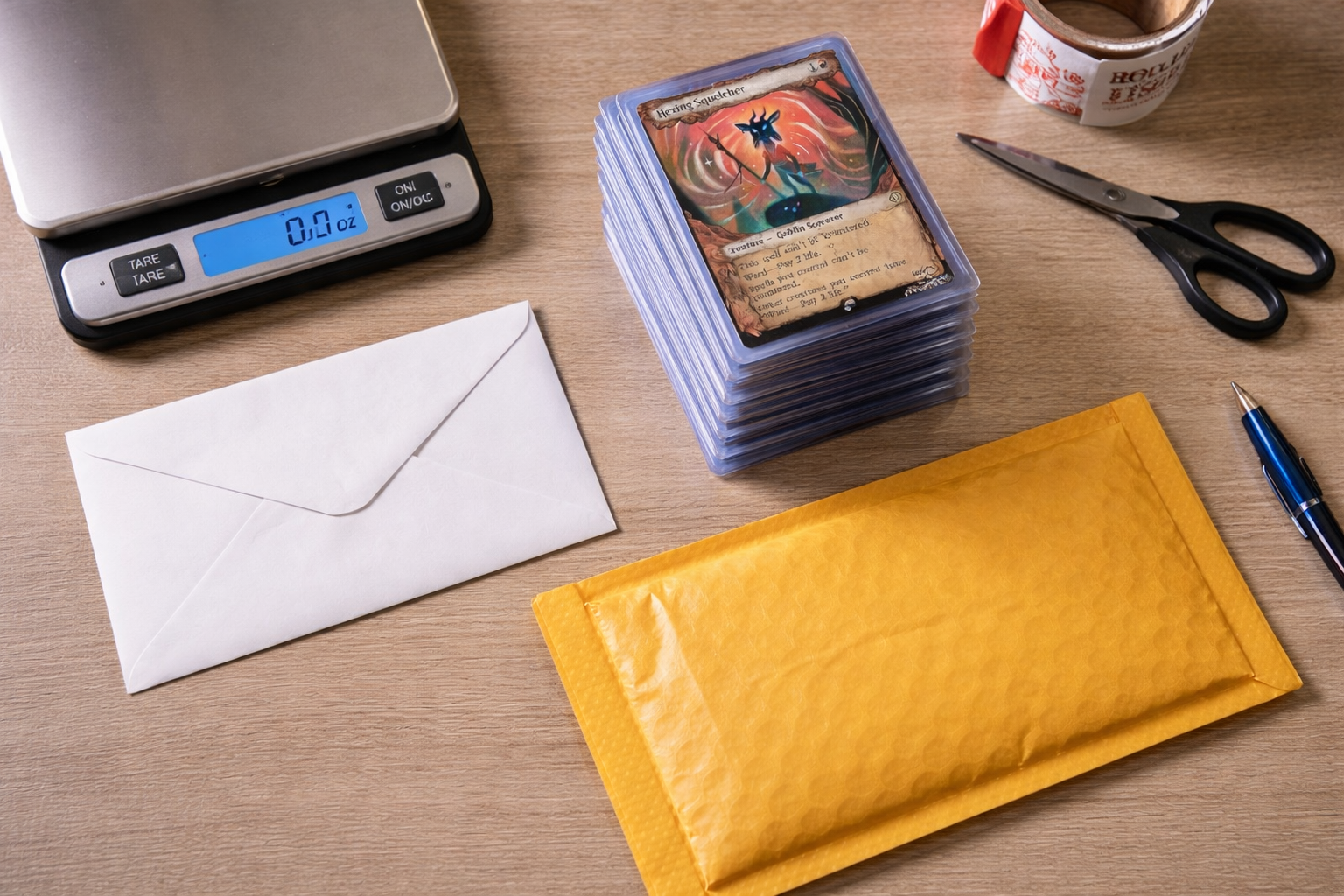
eBay Standard Envelope (ESE). This is the cheapest tracked shipping option for trading cards on eBay, starting around $0.68 for up to 1 oz. A playset of four cards in a penny sleeve and top loader easily fits within the weight limit. ESE provides tracking, which protects you from “item not received” claims.
Plain White Envelope (PWE). If ESE isn’t available for your listing, a standard stamped envelope works for low-value shipments. Current first-class stamp price covers a standard letter. The risk is no tracking, which means eBay will side with the buyer if they claim non-delivery. For playsets under $5.00, the math on PWE still works because the cost savings outweigh the occasional dispute.
Packaging the cards. Put all four cards in a single penny sleeve, then into a top loader. Tape the top loader opening shut (painter’s tape, not scotch tape, so the buyer can remove it without damaging the cards). Place the top loader in the envelope. For ESE shipments, make sure the envelope stays rigid and under the weight limit. If you’re not sure which top loaders to use, we put together a guide on the best top loaders for shipping trading cards on eBay.
Free shipping builds trust. I list all my playsets with free shipping and build the shipping cost into the price. Buyers strongly prefer free shipping listings, and eBay’s algorithm gives them a ranking boost.
Timing Your Playset Sales Around Standard Rotation
Standard rotation is the single biggest factor affecting the value of mtg standard legal cards. When a set rotates out, its cards are no longer legal in Standard, and demand from Standard players drops off sharply.
The Wizards Play Network maintains tournament rules and a sanctioning system that governs organized play at stores worldwide. The WPN also runs its own circuit of competitive events, from local Friday Night Magic up through Regional Championship Qualifiers, Regional Championships, and the Pro Tour. All of these events drive demand for Standard legal cards, and that demand follows the rotation calendar.
Here’s the selling timeline I recommend:
6+ months before rotation: Best time to sell Standard-only staples. Prices are near their peak and demand is strong from players who need the cards for the current season.
3 to 6 months before rotation: Prices start softening as informed players anticipate the upcoming rotation. Still a good window for selling, but don’t expect peak prices.
0 to 3 months before rotation: Sell aggressively if you’re still holding Standard staples. Prices decline faster as the rotation date approaches. Players start looking ahead to the next Standard format.
After rotation: Cards that only saw Standard play will drop significantly. However, cards that also see play in Pioneer, Modern, or Commander retain value. Check cross-format demand before panic-selling anything.
The next Standard rotation happens in early 2027 (with the first set release of the calendar year). Because Wizards of the Coast is skipping the 2026 fall rotation to realign the schedule, the current Standard card pool is larger than usual, which means more cards are legal and more playsets are worth listing. For a detailed breakdown of which sets rotate when, the Draftsim Standard Rotation Guide and the Star City Games Standard Rotation Guide are both excellent references to bookmark.
The Playset Listing Workflow (Step by Step)
Here’s the complete process I use to go from a box of Standard cards to eBay sales:
Step 1: Scan your collection. Use Manabox, Moxfield, or Archidekt to catalog your cards. Export the collection as a CSV file.
Step 2: Filter for Standard. In your collection app, filter by Standard legality. Remove anything that isn’t Standard legal unless you plan to list it separately for other formats.
Step 3: Identify playsets. Sort the filtered cards and group any card where you have four or more copies. Cards with fewer than four copies can still be listed as singles or partial playsets (label them clearly as “2x” or “3x” in the title).
Step 4: Price your playsets. Check TCG Low for each card, apply the 3.5x to 3.8x playset multiplier, and set your minimum listing threshold at $3.00.
Step 5: Generate eBay listings. Build your eBay-compatible CSV file using the data from your collection app export. Match each card to the correct eBay category, fill in item specifics (set, rarity, condition, game), and set your playset prices. If your collection app’s export doesn’t match eBay’s format directly, you can use a spreadsheet to reformat the columns.
Step 6: Upload to eBay. Use eBay’s bulk upload tool to push all your listings live at once. Review a few listings to make sure images, titles, and prices look correct.
Step 7: Package and ship as sales come in. Keep your playsets organized in a card box sorted alphabetically or by set so you can pull and ship orders quickly.
Common Mistakes Sellers Make with Standard Playsets
Listing at full retail with no playset discount. Buyers can do math. If your playset costs the same as buying four singles from different sellers, they’ll buy singles and potentially get better condition picks. Offer 5% to 12% off the combined single price.
Ignoring metagame shifts. A card that was a four-of staple last month might be completely absent from top decks this month. Standard metagames shift fast, especially after new set releases. Check tournament results regularly.
Holding through rotation hoping for a rebound. Unless a card has demand in Pioneer, Modern, or Commander, it’s not coming back after it rotates. Sell before the cliff.
Using vague titles. Your eBay listing title should include: card name, “Playset 4x” or “x4”, set name, condition, and “MTG” or “Magic the Gathering.” Example: “4x Stock Up Foundations NM MTG Standard Playset.” Clear titles get more clicks and help eBay’s search algorithm surface your listing.
Skipping item specifics. eBay’s algorithm heavily weights item specifics (set, rarity, card condition, game). Fill in every field. If you’re using a bulk listing tool, this may happen automatically. If you’re listing manually, don’t skip it.